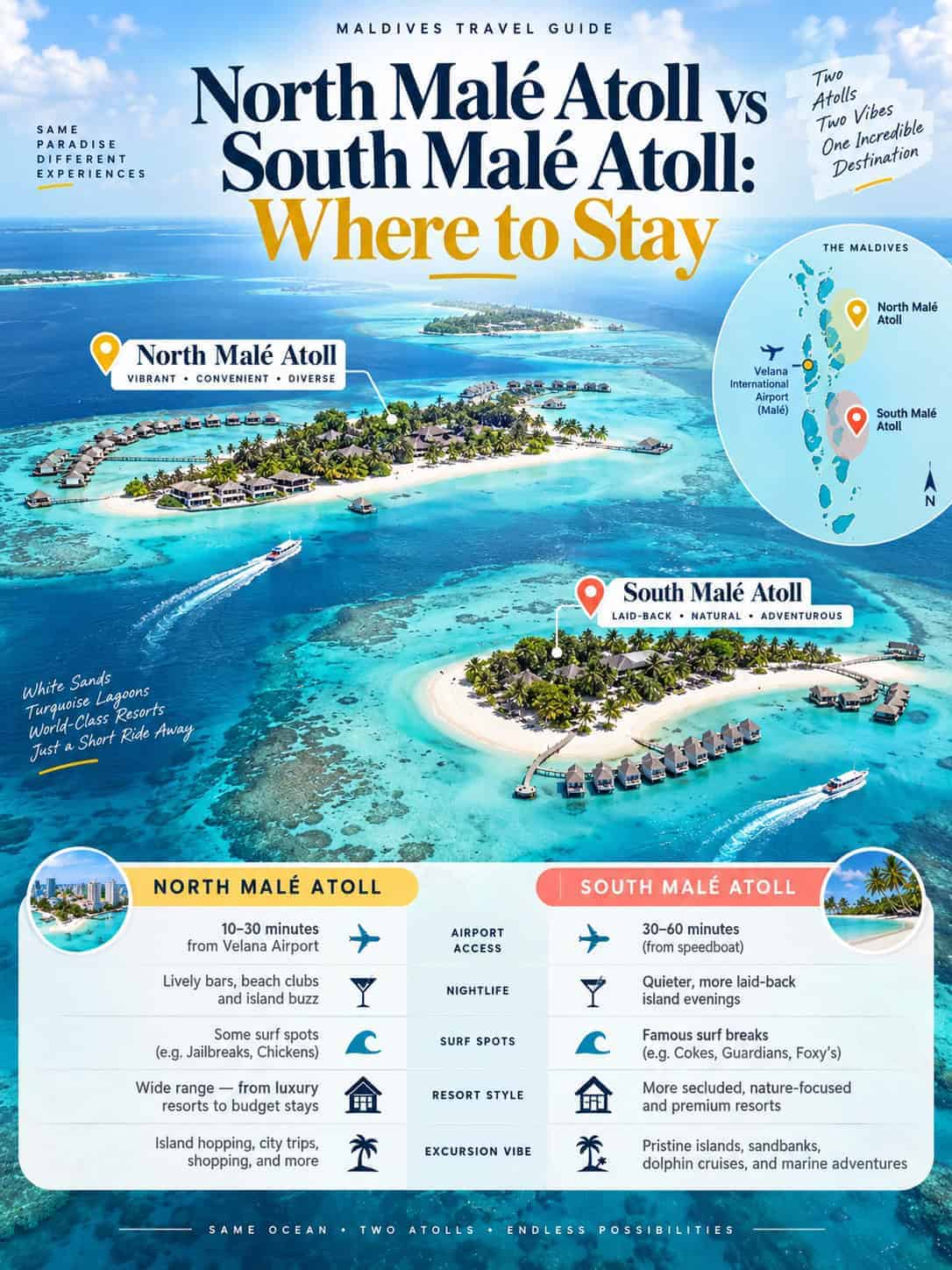
Velana International Airport sits right between North and South Malé Atoll, which means every resort in both atolls is, strictly speaking, close to the airport. The North Male Atoll vs South Male Atoll question comes up constantly because the two feel so different despite the short distance between them. The real choice has nothing to do with distance and everything to do with what kind of week you actually want: busier and more surf-oriented, or quieter and better suited to drift diving. If you are asking which Male atoll to choose, this north Male atoll resorts comparison covers surf, diving and the south Male atoll surf question, dimension by dimension.
North Male Atoll vs South Male Atoll at a Glance
| North Malé Atoll | South Malé Atoll | |
|---|---|---|
| Speedboat transfer | About 10–60 minutes | Roughly 15–45 minutes |
| Feel | Busier, highest resort density | Quieter, fewer islands |
| Surfing | Established hub (Thulusdhoo, Himmafushi) | Smaller scene around Guraidhoo and Kandooma |
| Diving | Manta rays, Banana Reef, Maldives Victory wreck | Drift diving in channels, Embudhoo Express |
| Best for | First trip, choice, surf, mantas | Repeat visit, quiet water, drift dives |
Transfer Time: A Wash, Not a Deciding Factor
Both atolls sit close enough to Velana International Airport that nobody needs a seaplane to reach them. North Malé speedboat transfers run from about 10 minutes (Niva Kurumba, Bandos) to about 60 (Meeru), and South Malé transfers roughly 15 to 45 minutes depending on the resort, with Taj Exotica on the South Malé side among the shortest at around 15 to 20 minutes, while Anantara Veli and Dhigu take about 30 to 35 minutes. Speedboats run day and night in both atolls, timed to your flight, and airport transfers can be booked in advance if you are staying in Malé first. If transfer time alone decided the question, it would be a tie. It isn’t the deciding factor, so look past it. The fare differs more than the minutes, because each resort sets its own: Villa Nautica in North Malé charges $185 per adult and $98 per child under 12 for the shared round trip, Fihalhohi in South Malé $180 per adult and $90 per child aged 2-14, and Sun Siyam Olhuveli $260 return per adult aged 15 and over, with up to two children aged 2-14 free. That is why which Male atoll to choose is really a question about style, not distance.
North Male Atoll Resorts: Choose North Malé for More Choice and a Livelier Feel
North Malé Atoll has the largest concentration of resorts in the Maldives, roughly 30 resort islands depending on the count, and is widely considered the busiest atoll in the country, in the sense of having the most islands developed and the most boat traffic moving between them. That density is also its advantage: more resorts means more price points and more styles of property packed into a shorter transfer radius, from Baros (5-star, ultra-luxury) and One&Only Reethi Rah (5-star, ultra-luxury) to Gili Lankanfushi (5-star, ultra-luxury) and Four Seasons Kuda Huraa (5-star, luxury). If choice and flexibility matter more than isolation, this is the atoll to search in first. In any north Male atoll resorts comparison, density and choice are the main selling points.
South Male Atoll Resorts: Choose South Malé for Fewer Islands and Quieter Water
South Malé Atoll has noticeably fewer developed islands and calmer, less trafficked water than its northern neighbor. Resorts here lean toward a quieter, more private feel: Taj Exotica (5-star, luxury), COMO Cocoa Island (5-star, ultra-luxury), Naladhu Private Island (5-star, ultra-luxury), Anantara Dhigu (5-star, luxury), Anantara Veli (5-star, adults-only luxury), and Kandooma Maldives (formerly Holiday Inn Resort Kandooma, 4-star, mid-range) for travelers who want the atoll’s surf and dive access without ultra-luxury pricing. If the goal is fewer boats in the frame of every photo, South Malé wins this comparison.
Choose North Malé If You’re Here to Surf
North Malé is the Maldives’ established surf hub, built around a cluster of breaks: Cokes and Chickens off Thulusdhoo, Jailbreaks off Himmafushi, and Sultans and Honkys off Thanburudhoo. The main surf season runs roughly April through October, peaking from June to September. Surf charters and surf-focused guesthouses on Thulusdhoo (see our Thulusdhoo surfing guide) specifically cater to this scene, something South Malé does not have at the same scale. By contrast, the south Male atoll surf scene is small, so surfers should look north.
Not every wave is open to everyone. Pasta Point is reserved for Cinnamon Dhonveli guests on surf packages, and Lohi’s for a capped number of Adaaran Select Hudhuranfushi guests with a surf pass, so a room-only booking at either resort does not include the break. Everyone else surfs the public breaks, with Sultans and Honkys reached by boat. South Malé has its own named waves: Kandooma Right, in front of Kandooma Maldives and effectively kept for its surf-package guests, Riptides off Guraidhoo, and Quarters, Twin Peaks, Gurus and Natives by boat or charter. The southern breaks peak in September and October, later than the North Malé swell, so a late-season surf trip is the one case where South Malé deserves a serious look.
Choose South Malé If You’re Here to Dive, Especially Drift Dives
South Malé’s diving identity is built on channels with real current, the kind of drift diving that rewards experienced divers. Embudhoo Express is the signature site, a roughly two-kilometer channel drift at about 5 to 30 meters, usually dived on the incoming tide, past grey and whitetip reef sharks, eagle rays, Napoleon wrasse, and trevally. Kandooma Thila, a pinnacle with its top at about 12 meters that drops to roughly 40, and Guraidhoo Corner (about 12 to 40 meters) round out the channel diving. Conditions vary by site and monsoon, so ask the dive center which channel is best on your dates. South Malé is not a hammerhead destination, though; schooling hammerheads are a Rasdhoo Atoll specialty, a separate atoll entirely.
Choose North Malé If Manta Rays Are the Priority
North Malé has manta cleaning stations where manta rays gather, Lankan Manta Point being the best known, with sightings generally better during the May-to-November southwest monsoon. North Malé also holds Banana Reef (about 5 to 30 meters), one of the Maldives’ original named dive sites, HP Reef (also called Rainbow Reef) for soft coral and overhangs, and the Maldives Victory wreck, a cargo ship that ran aground on the Hulhulé reef on 13 February 1981 with no lives lost, now covered in marine growth, with the bow at roughly 5 meters and the stern at about 35. If manta ray encounters are the single must-have experience, this points toward North Malé over South.
North Male Atoll vs South Male Atoll: The Practical Shortcut
If this is a first Maldives trip and maximum choice matters most, start the resort search in North Malé. If this is a repeat trip, or the goal is specifically quieter water, drift diving, or a smaller crowd, search South Malé instead. Neither atoll requires a seaplane (see seaplane vs speedboat for when you do), both are reachable within about an hour of landing, and both can be combined with a one-night stopover in Malé itself for travelers curious about the capital before heading out to the reef. That is the short answer to which Male atoll to choose.
Budget Range: Both Atolls Span Wide, But Differently
Neither atoll is exclusively a budget or luxury zone, but the shape of the market differs. North Malé’s sheer resort density means it has both the Maldives’ most expensive private-island properties and a meaningful cluster of 4-star options squeezed in between them, along with local-island guesthouses on Thulusdhoo and Himmafushi for surfers and travelers working with a tighter budget who still want proximity to the airport. South Malé’s resort count is smaller, so the price spread is narrower and skews slightly more upmarket on average, though Kandooma Maldives remains one of the more accessible overwater-villa options in either atoll. For guesthouse budgets, South Malé has the stronger hand: Maafushi, the best-known guesthouse island, and Guraidhoo, next to the Kandooma and Riptides breaks, are both on its side of the channel.
Day Trips and What’s Nearby
North Malé’s density cuts both ways: more resorts means more inter-island boat traffic is visible from the water, but it also means excursion operators can reach a wider variety of sites, sandbanks, and local islands within a short ride, and the capital, Malé, itself is typically a quick speedboat hop away for a half-day city visit. South Malé’s quieter water makes for calmer excursion boat rides and more consistent snorkeling visibility on days when wind picks up elsewhere, though the atoll has fewer local islands to visit casually compared to North Malé’s cluster around Thulusdhoo, Himmafushi, and Huraa.
When to Visit Either Atoll
Both atolls follow the same two-monsoon pattern that governs the whole Maldives, covered in our best time to visit the Maldives guide. The dry, sunnier northeast monsoon runs roughly December through April and is the more reliable window for calm seas and consistent visibility in both North and South Malé. The wetter southwest monsoon, May through November, brings more rain and wind but is also when North Malé’s manta stations see more activity and when many South Malé channels run with stronger current. In practice, the “best” season depends on whether the trip is built around calm beach days or around diving and manta encounters.
Can You Combine Both Atolls in One Trip?
Yes, and it’s more practical here than almost anywhere else in the Maldives, because both atolls sit so close to the airport and to each other. A split stay, a few nights at a North Malé resort for the surf and manta access, followed by a few nights in South Malé for quieter water and channel diving, avoids the long seaplane transfers that make multi-atoll trips to outer atolls like Baa or Addu more complicated. Resorts in both atolls are used to guests arriving directly from another Malé-area property rather than from the airport, so transfer logistics are simpler than they look on a map.
House Reef Quality: Another Point in South Malé’s Favor
Because South Malé has fewer resorts and less boat traffic overall, several of its house reefs have stayed in better condition than some of the more heavily trafficked reefs in North Malé’s busiest pockets. That is a generalization with exceptions on both sides, since reef health depends heavily on individual resort management and past bleaching events, but travelers prioritizing snorkeling straight off the beach, without a boat excursion, often find South Malé’s calmer, less congested house reefs the more consistent option.
North Male Atoll vs South Male Atoll: FAQ
Which is better, North Malé Atoll or South Malé Atoll?
North Malé suits a first trip, surf and manta rays, while South Malé suits quieter water and drift diving.
Do I need a seaplane for North or South Malé?
No. Both atolls are reached by speedboat from Velana International Airport, in about 10 to 60 minutes in North Malé and roughly 15 to 45 minutes in South Malé.
Which atoll has better diving?
It depends on the dive: North Malé for manta rays and classic reef sites, South Malé for channel and drift diving.
Can I stay in both atolls on one trip?
Yes. Both sit close to the airport and to each other, so a split stay avoids long seaplane transfers.
North vs South Malé in Numbers: Transfers, Ferries and Beds
Public ferries do not run on Fridays, so a Friday arrival means a shared or private speedboat.
| Fact | Number |
|---|---|
| Speedboat transfer from Velana airport | About 10–60 minutes in North Malé, roughly 15–45 minutes in South Malé |
| Taj Exotica (South Malé) | About 15–20 minutes |
| Anantara Veli and Dhigu (South Malé) | About 30–35 minutes |
| Resort islands in North Malé | Roughly 30, depending on the count |
| Guesthouses on Maafushi (March 2022) | 46 guesthouses with 1,578 beds |
| Guesthouses in Greater Malé (2022) | 74 guesthouses with 2,362 beds |
| Public ferry Malé to Maafushi | About $3 per person and about 90 minutes, leaving Malé at 15:00 Saturday to Thursday; a shared speedboat costs about $25 and takes about 45 minutes |
| Public ferry Malé to Thulusdhoo | About MVR 45 (roughly $3) and about 75 minutes; a shared speedboat costs about $30 and takes 25–35 minutes |
| Maldives Victory wreck | Ran aground on 13 February 1981; bow about 5 m, stern about 35 m |