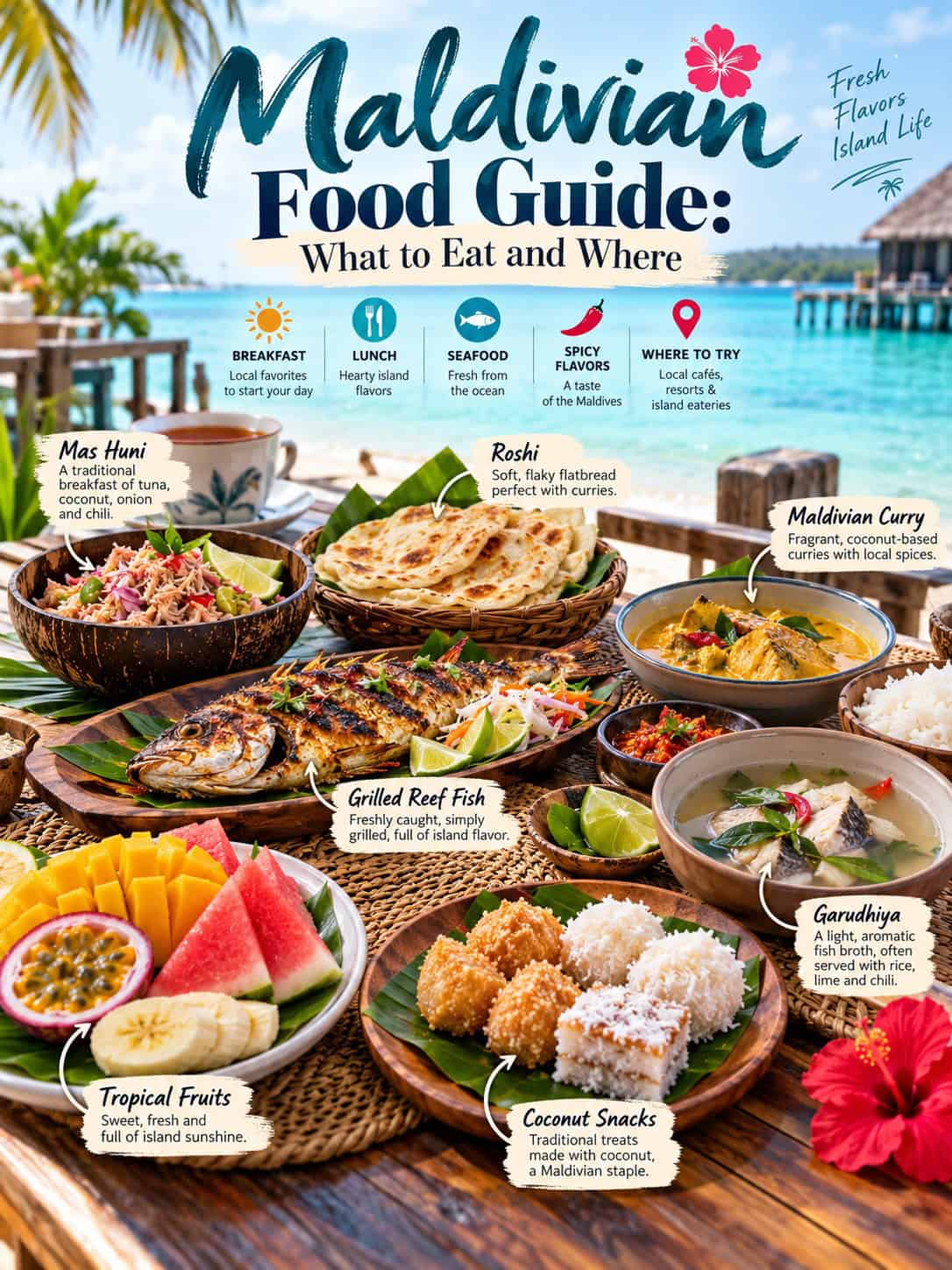
What to eat in the Maldives? Maldivian food is the dish-by-dish answer. Most resort buffets in the Maldives serve a careful blend of international dishes with a few local flourishes stirred in, which means most visitors leave without ever tasting actual Maldivian food. Maldivian cuisine is built almost entirely around three ingredients: fish (overwhelmingly tuna), coconut, and rice, prepared in ways that have changed very little over generations. Here’s what Maldivian cuisine actually is, dish by dish, from mas huni to garudhiya.
Mas Huni: The Everyday Maldivian Breakfast
Mas huni is the dish most Maldivians grow up eating most mornings. It’s a simple mixture of tuna (often smoked), grated coconut, onion, chili, and lime, mixed together and served with roshi, a round unleavened flatbread similar to chapati. The combination is bright, slightly sour from the lime, and textured from the coconut, and it’s eaten by hand, scooped up with torn pieces of roshi. It rarely appears on resort breakfast buffets in its authentic form, which makes it one of the easiest ways to tell whether a kitchen is actually cooking Maldivian food or just plating something labeled “local.”
Garudhiya: The Maldivian Fish Soup That Shows Up All Week
Garudhiya is a clear fish soup, usually made with tuna, and it’s less a single dish than a daily staple eaten with rice (called baiy) throughout the week. Diners customize their own bowl at the table, adding lime, chili, and onion to taste. It’s commonly served alongside fried fish, boiled yam, boiled sweet potato, and theluli faiy, fried moringa leaves, which get added into the soup or eaten on the side. The broth itself is light, more about the fish flavor than heavy seasoning, which is part of why it’s eaten so often without becoming repetitive.
Hedhikaa: Maldivian Food for Tea Time
Hedhikaa, often translated as “short eats,” are the small fried and savory snacks served at evening tea, the Maldivian equivalent of a tapas spread. A few specific items show up constantly:
Kulhi boakibaa is a spiced fish cake or pie. Bajiyaa is a small, triangular, samosa-like pastry typically filled with a mixture of tuna, coconut, and onion, deep-fried until crisp. Mas roshi is a flatbread stuffed with a filling of tuna and grated coconut. Gulha, deep-fried tuna-and-coconut balls, round out the usual short eats spread, built around the same base that defines so much of Maldivian cooking. These are the dishes found piled on trays at local cafés, known as “hotaa,” across Malé and the inhabited islands, usually priced cheaply enough that a full tea-time spread costs a fraction of a resort snack.
Maldivian Food for Celebrations: Bon’di Baiy and Kulhi Mas
Bon’di baiy is sweetened sticky rice, traditionally made for festive occasions and specifically to mark a child’s birth, when it’s shared with neighbors, friends, and extended family rather than kept within one household. It’s eaten paired with kulhi mas, a chili fish dish that provides a savory, spicy contrast to the rice’s sweetness. The pairing is less an everyday meal than a marker of celebration, and visitors are unlikely to encounter it outside a local island homestay or a guesthouse that specifically arranges a cultural meal.
Coconut and Rice: The Constants Underneath Everything
Grated coconut appears in nearly every dish listed above, either raw and mixed in (as in mas huni) or cooked into fillings (as in bajiyaa and mas roshi), and it functions as the primary source of richness in a cuisine that otherwise uses very little dairy or oil-based sauces. Rice, meanwhile, is almost entirely imported but is less a side dish than the backbone of the main meal, with baiy served alongside garudhiya at most daily meals the way bread might anchor a meal elsewhere. What to eat in the Maldives comes down to fish, coconut and rice: together they make up the overwhelming majority of what gets cooked in a Maldivian home kitchen on any given day, a contrast to the more internationally varied menus most resorts actually serve.
What to Eat in the Maldives and Where to Find It
Resort restaurants occasionally run a “Maldivian night” with a curated, often toned-down version of some of these dishes, but the real thing is found on local islands and in Malé’s hotaa cafés, where short eats are piled on trays throughout the afternoon and evening and a full plate of garudhiya and rice costs a small fraction of a resort meal. Guesthouse stays on islands like Maafushi or Thulusdhoo (see our budget guesthouses guide) increasingly include a home-cooked Maldivian meal as part of the package specifically because so many visitors ask for it after realizing the resort buffet isn’t representative. For travelers staying resort-only who ask what to eat in the Maldives, asking directly whether the kitchen can prepare mas huni or garudhiya rather than a resort-style approximation is usually the simplest way to get something closer to the real dish. Guided local-island trips and food-focused excursions can be compared and booked in advance, and our guide to resort island vs local island explains where each kind of food is found. For anyone curious where the tuna actually comes from, Malé’s fish market is worth a visit to see the catch come in, with boats unloading mostly in the afternoon, before it ends up in a bowl of garudhiya.
Where to Try Each Dish
| Dish | On a local island or in Malé | At a resort |
|---|---|---|
| Mas huni with roshi | Breakfast at guesthouses and hotaa cafés | Rarely on the buffet in its real form; ask the kitchen to make it |
| Garudhiya with rice | Lunch or dinner at local eateries and guesthouse tables | Sometimes at a Maldivian night, otherwise on request |
| Hedhikaa (bajiyaa, gulha, kulhi boakibaa, mas roshi) | On hotaa trays from the afternoon into the evening, with sai | Toned-down versions at afternoon tea or a Maldivian night |
| Bon’di baiy with kulhi mas | Celebrations, or a cultural meal arranged by a homestay or guesthouse | Almost never |
A Food Culture Shaped by Geography
What to eat in the Maldives is shaped by geography, and none of this is accidental. With almost no arable land across the Maldives’ coral islands, agriculture was never a realistic food source the way it is in most countries, so the cuisine built itself almost entirely around what the ocean and a handful of hardy plants, coconut palms, breadfruit, and a few root vegetables like yam and sweet potato, could reliably provide. Only about 27 square kilometres of land is cultivable and roughly 90% of food items are imported; fish is the one staple that does not have to be. That constraint is still visible in every dish on this list: there is no Maldivian cuisine without the reef and the open ocean immediately offshore, which is part of why the food tastes so specifically of a place rather than drawing on influences the way Indian Ocean cuisines further from the Maldives sometimes do.
What Locals Actually Drink
Sai, sweet milk tea similar to Indian chai, is the default drink served alongside hedhikaa at tea time, usually strong, heavily sweetened, and served in small glasses rather than large mugs. Fresh fruit juices, mango, papaya, and watermelon among the most common, are widely available from juice stalls on local islands and in Malé, usually blended fresh rather than bottled. Raa, a naturally fermented palm toddy tapped from coconut palms, has a long history in Maldivian culture, though its availability varies since alcohol is tightly restricted outside resort islands; the non-alcoholic, freshly tapped version is more commonly what’s served to visitors on local islands.
Spice Level and Flavor Profile
Maldivian food leans spicier than many visitors expect going in, particularly dishes built around dried chili and fresh chili paste, but the heat tends to sit alongside sourness (lime) and brightness (raw onion, fresh coconut) rather than overwhelming a dish the way some South Asian curries can. Rihaakuru, a thick tuna-based sauce made by slow-cooking fish broth down to a paste, is eaten almost daily with rice, roshi, taro or breadfruit and is one of the most distinctly Maldivian ingredients.
Eating Maldivian Food as a Vegetarian
Traditional Maldivian cuisine is built so heavily around fish that vegetarian travelers will find relatively few authentic local dishes to choose from; nearly every signature dish on this list, mas huni, garudhiya, the hedhikaa varieties, and kulhi mas, centers on tuna. The closest vegetarian-friendly options are sides rather than full dishes: boiled yam and sweet potato served alongside garudhiya, roshi eaten plain or with coconut, and bon’di baiy, the sweetened sticky rice, which is naturally vegetarian on its own even though it’s traditionally paired with fish. Resort kitchens are generally well equipped to adapt, but travelers seeking an authentic vegetarian version of Maldivian food specifically, rather than an international vegetarian dish served at a Maldivian resort, should expect a genuinely narrow menu. On local islands, ask for baraboa mas huni, made with pumpkin in place of tuna, or tharukaaree riha, a vegetable curry, and say clearly that you eat no fish. For a complete change of scenery from hotaa trays and home-cooked garudhiya, some resorts also run underwater restaurants where the view, rather than the local flavor, is the main draw.
Allergies, Halal Food and Ramadan
Fish and coconut run through almost every dish in this guide, including the short eats, whose fillings are usually tuna and grated coconut, so travelers with a fish or coconut allergy should ask before taking anything from a hotaa tray. Roshi is a wheat flatbread, which makes gluten-free eating harder on local islands, and resort kitchens are better set up for severe allergies than small cafés.
All meat served on local islands is halal. Alcohol is served only on resort islands and licensed safari boats, and pork only at resorts, which almost always have halal options too.
During Ramadan, eating, drinking and smoking in public in daytime are not allowed outside resorts, and most cafés on local islands stay closed until sunset, though guesthouses usually serve their own guests meals privately during the day. The daytime rule does not apply on resort islands. Ramadan 2027 is expected to begin around 8 February, with Eid al-Fitr on 9 or 10 March depending on the moon sighting.
Maldivian Food in Numbers: Prices and Facts
Local prices vary by island and are lowest at hotaa cafés; pay in rufiyaa, because prices quoted in dollars on local islands are often rounded up. The fish and import figures show why tuna sits at the center of every dish above.
| Maldivian food fact | Number |
|---|---|
| Short eats such as bajiyaa and gulha in a local café | Roughly MVR 3–15 each (about $0.20–1) |
| A meal in a local eatery | Roughly MVR 60–120 (about $4–8) |
| Mas huni in a local café or guesthouse | Roughly MVR 35–80 |
| A bowl of garudhiya on a local island | Roughly MVR 50–100 |
| Seafood eaten per person | About 85–87 kg a year, among the highest in the world |
| Tuna catch (2020) | About 146,800 tonnes, roughly 70% skipjack and 26% yellowfin |
| Fishing methods allowed | Pole-and-line and handline only; pole-and-line landed 99% of the skipjack in 2020 |
| Food items imported | About 90% |
| Cultivable land | About 27 square kilometres |