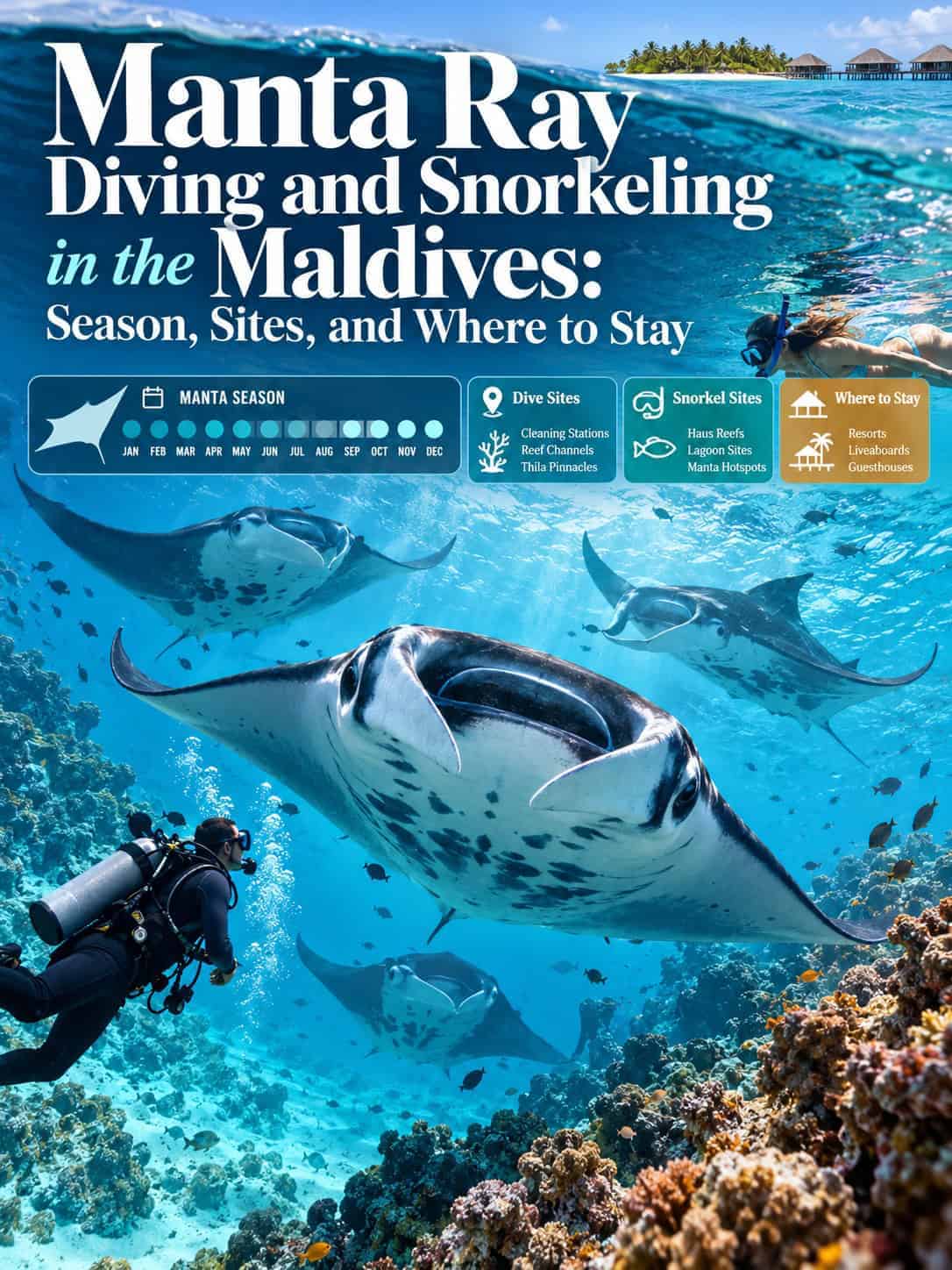
Manta rays Maldives encounters depend on the season and atoll. Reef mantas gather at different feeding and cleaning sites as monsoon-driven currents change. The country sits across two monsoons that flip which side of each atoll gets plankton-rich water every few months, so the mantas simply move with the current, and the dive sites that work in April are often empty by September. Choosing an atoll for its seasonal manta activity improves your chances, but sightings are never guaranteed.
Manta Rays Maldives: Reef vs Oceanic Species
Two different manta species show up in Maldivian waters, and they behave nothing alike. Reef manta rays (Mobula alfredi) are the ones most divers actually see: smaller, more coastal, and loyal to specific cleaning stations on the reef where they return day after day to have parasites picked off by cleaner wrasse. Oceanic manta rays (Mobula birostris) are the giants — wingspans past 5 metres — and they pass through more unpredictably, usually following plankton blooms rather than sticking to a fixed spot. Most of what gets called “manta ray diving Maldives” on a normal dive trip is reef mantas at cleaning stations; oceanic mantas are the rarer, more opportunistic sighting, usually in the channels and outer reefs of atolls like Fuvahmulah and Laamu.
Hanifaru Bay Maldives: Snorkeling Rules and Season
If there’s one name that comes up in every conversation about Hanifaru Bay manta rays, it’s because the site genuinely earns the reputation. Tucked inside Baa Atoll’s UNESCO Biosphere Reserve, Hanifaru is a shallow bay — depths run from about 2 to 30 metres — where tidal currents funnel plankton into a dead end, and reef mantas (sometimes joined by whale sharks) show up to feed in numbers that don’t happen almost anywhere else on Earth. Manta aggregations at Hanifaru are most commonly reported during the southwest monsoon, especially from May through November. Strong plankton blooms and lunar tides influence each encounter. Whale sharks sometimes join the feeding mantas, but encounters with either species depend on local conditions. Do not book a particular week expecting both.
The catch: Hanifaru is snorkel-only. Scuba diving is banned inside the bay to protect the feeding mantas from bubbles and equipment, so this is one of the rare cases where snorkeling with manta rays in the Maldives actually beats diving for it. Hanifaru visits are regulated: snorkeling is limited to 45 minutes per group, and visitors must stay at least 3 metres from mantas and whale sharks. Scuba diving, underwater scooters and flash photography without special written permission are prohibited. Book through an authorized guide or operator.
Manta Rays Maldives: Seasonal Sightings by Atoll
The manta ray season in the Maldives isn’t one date range — it’s a rotation driven by the two monsoons. The southwest monsoon (roughly May to November) pushes plankton-rich water onto the eastern sides of the atolls, which is why Baa Atoll and North Malé Atoll both peak in that window. The northeast monsoon (December to April) reverses it, pushing the richer water west, which is when sites like Rasdhoo’s manta cleaning station become more reliable. In practice, that means there’s almost always a manta site working somewhere in the Maldives — the question is just which atoll matches which month.
Manta Rays Maldives: Best Atolls by Season
| Atoll / site | When mantas are commonly seen | Best activity | Important distinction |
|---|---|---|---|
| Baa — Hanifaru Bay | May–November; conditions may also be favourable into December | Guided snorkeling | Scuba diving prohibited inside the bay |
| South Ari — Rangali Madivaru | December–April | Scuba diving | Cleaning station, not Hanifaru-style feeding aggregation |
| North Malé — Lankan Manta Point | May–November | Scuba diving | Visits depend on currents and operator access |
| Addu — Maa Kandu (Mudakan Manta Point) | Year-round | Scuba diving | Cleaning station; suitable experience level depends on conditions |
| Fuvahmulah — Farikede | March–April peak | Advanced guided diving | Oceanic manta encounters are less predictable |
These are seasonal patterns, not sighting guarantees. Ask operators about recent sightings and sea conditions before choosing a tour.
- North Malé Atoll — Lankan Manta Point, on the atoll’s southeast side, is most active from May through November. Visits depend on currents and operator access.
- Baa Atoll — Hanifaru Bay is most commonly reported from May through November, described above.
- Rasdhoo Atoll — a shallow cleaning station works best November through April, the reverse of the North Malé pattern.
- South Ari Atoll — the Rangali Madivaru cleaning station works best from December through April.
Manta Rays Maldives: Where to Dive or Snorkel
Lankan Manta Point in North Malé Atoll is the closest serious manta dive to the airport, which makes it the easiest to add onto a short trip. The reef slopes to around 24 metres, but most of the action happens around 15 metres at the cleaning stations themselves, where mantas queue up to be cleaned and divers are asked to hover slightly below and off to the side rather than approach head-on — getting too close just pushes the manta off its own cleaning station. Currents and drift-diving comfort matter more here than raw certification level; this isn’t a beginner site, even though the depth itself is moderate.
Rasdhoo’s cleaning station sits in shallower water and works well for both diving and snorkeling once the season turns. South Ari Atoll has established manta cleaning stations, including Rangali Madivaru. Reef mantas regularly use this site during the northeast monsoon, especially December through April. Whale shark excursions are a separate activity and do not guarantee manta sightings.
Manta Rays Maldives: Do You Need Diving Certification?
Not necessarily. Hanifaru Bay is snorkel-only by law, so certification is irrelevant there — a mask, fins, and the ability to swim comfortably in open water is the real requirement. Lankan Manta Point and Rasdhoo’s cleaning station, on the other hand, are proper dive sites, and most dive centers will want at least an Open Water certification plus comfort with currents before booking a boat out to them, since conditions can shift fast once the tide turns. If diving isn’t in the plan, snorkeling with manta rays in the Maldives is a completely legitimate way to see them — Hanifaru proves that better than anywhere else in the country.
Hanifaru Bay Maldives: Rules, Fees and Tour Costs
| Item | Published amount or rule | What it covers |
|---|---|---|
| Official protected-area visit fee | MVR 310 per person, resort channel, published for May 1–December 1, 2026 | Protected-area access; not a complete guided tour |
| Maximum snorkeling time | 45 minutes per visiting group | Time in Hanifaru Bay waters |
| Minimum animal distance | 3 metres | Mantas and whale sharks; remain still if one approaches |
| Blueworld Dharavandhoo — snorkeling excursion | US$23, plus a listed US$20 Hanifaru fee | Operator’s published example; taxes/fee treatment require confirmation |
| Blue World dive centre — 1–5 dives | US$60 per dive before taxes and extra rental charges | Published dive-centre rate; not scuba inside Hanifaru Bay |
| Muraka Diving, Addu — 1–5 dives | US$80 per dive, tax included | Boat, tank and weights; rental equipment extra |
Ask whether the quote includes boat transfers, equipment, a licensed guide, the protected-area fee, service charge and tourism tax. Published operator rates may change; do not confuse ordinary diving elsewhere in Baa Atoll with snorkeling inside Hanifaru Bay. You can also browse manta and snorkeling excursions in advance.
Manta Rays Maldives: Where to Stay by Atoll
Basing a trip around manta season means picking a resort close to whichever atoll is peaking. In North Malé Atoll, Baros Maldives and Niva Kurumba Maldives are established resorts. Ask their dive centres whether they currently run excursions to Lankan Manta Point. Boat times and manta sightings depend on the departure point and sea conditions. For Baa Atoll, consider Soneva Fushi or Royal Island Resort & Spa. Both are in the wider atoll, but confirm whether Hanifaru excursions operate on your dates and whether the protected-area fee is included. For Rasdhoo-area diving on Ari Atoll, check the current dive programmes of Niva Kuramathi Maldives and Veligandu Maldives Resort Island. Ask for the exact dive site and round-trip boat time before booking. Whichever island ends up on the booking, it’s worth checking directly with the resort’s dive center on current manta activity before locking in dates — the season windows above are reliable patterns, not guarantees for any single week.
For travelers still comparing accommodation options across the country rather than one specific atoll, it’s worth browsing places to stay by region before locking in a manta-season trip, since transfer time to the right dive site can matter more than the resort’s star rating.
Manta Rays Maldives: Conservation and Safety Rules
Manta rays are protected species in the Maldives, and most of the “rules” divers run into are there because the mantas themselves are sensitive to disturbance. The basics: never touch a manta, never chase one that’s swimming away, approach cleaning stations from the side rather than head-on, keep a reasonable distance (most dive operators enforce 3 metres or more), and skip flash photography, since it’s banned outright at sites like Hanifaru and discouraged everywhere else. Large group sizes are capped at several of the busiest sites specifically to keep the mantas coming back — a site that gets crowded out by divers or snorkelers will eventually stop being reliable.
Manta Rays Maldives: Frequently Asked Questions
What is the best time of year for manta ray diving in the Maldives?
It depends on the atoll. Baa Atoll’s Hanifaru Bay is most commonly reported from May through November, North Malé Atoll’s Lankan Manta Point is active from May through November, South Ari’s Rangali Madivaru works best from December through April, and Rasdhoo’s cleaning station is best November through April. There’s no single best month for the whole country — it shifts with the monsoon.
Can you see manta rays without scuba diving?
Yes. Hanifaru Bay in Baa Atoll is snorkel-only by law, and it is one of the best-known manta aggregation sites in the Maldives, so snorkeling is a completely valid way to see them at that specific site. Sightings are never guaranteed.
What’s the difference between a manta cleaning station and a feeding site?
A cleaning station is a fixed spot on the reef where mantas return repeatedly to have parasites removed by cleaner fish, like Lankan Manta Point or Rasdhoo’s shallow site. A feeding aggregation, like Hanifaru Bay, happens when tidal currents concentrate plankton in one place and mantas (sometimes with whale sharks) gather to eat — it’s a different behavior and often a much larger group.
Do I need to be an experienced diver to dive with manta rays in the Maldives?
Most manta dive sites in the Maldives involve some current, so dive centers generally want at least Open Water certification and comfort with drift diving rather than a beginner-only skill set. Snorkeling with mantas, particularly at Hanifaru Bay, doesn’t require diving certification at all.
How much does a manta snorkeling excursion cost?
A Dharavandhoo dive centre publishes US$23 for a basic snorkeling trip plus a separate US$20 Hanifaru fee. Check the total, taxes, equipment and transport before paying.
Can you scuba dive in Hanifaru Bay?
No. Scuba diving is prohibited within the protected bay. Nearby Baa Atoll reefs offer separate scuba trips.
How long can you snorkel at Hanifaru Bay?
Guided groups may remain in the water for a maximum of 45 minutes.
How close can you swim to a manta ray?
Hanifaru regulations require at least 3 metres of separation. Do not chase or obstruct an animal’s path.
Is Addu Atoll good for seeing mantas?
Yes. Maa Kandu is a documented year-round cleaning station, though individual sightings are not guaranteed.
Should you choose Hanifaru or a cleaning station?
Choose Hanifaru for seasonal snorkeling with feeding mantas. Choose a suitable cleaning station for a scuba-focused trip.
Are manta rays dangerous to swimmers?
Manta rays are filter-feeding fish without a venomous sting. Keep your distance and follow your guide’s instructions.