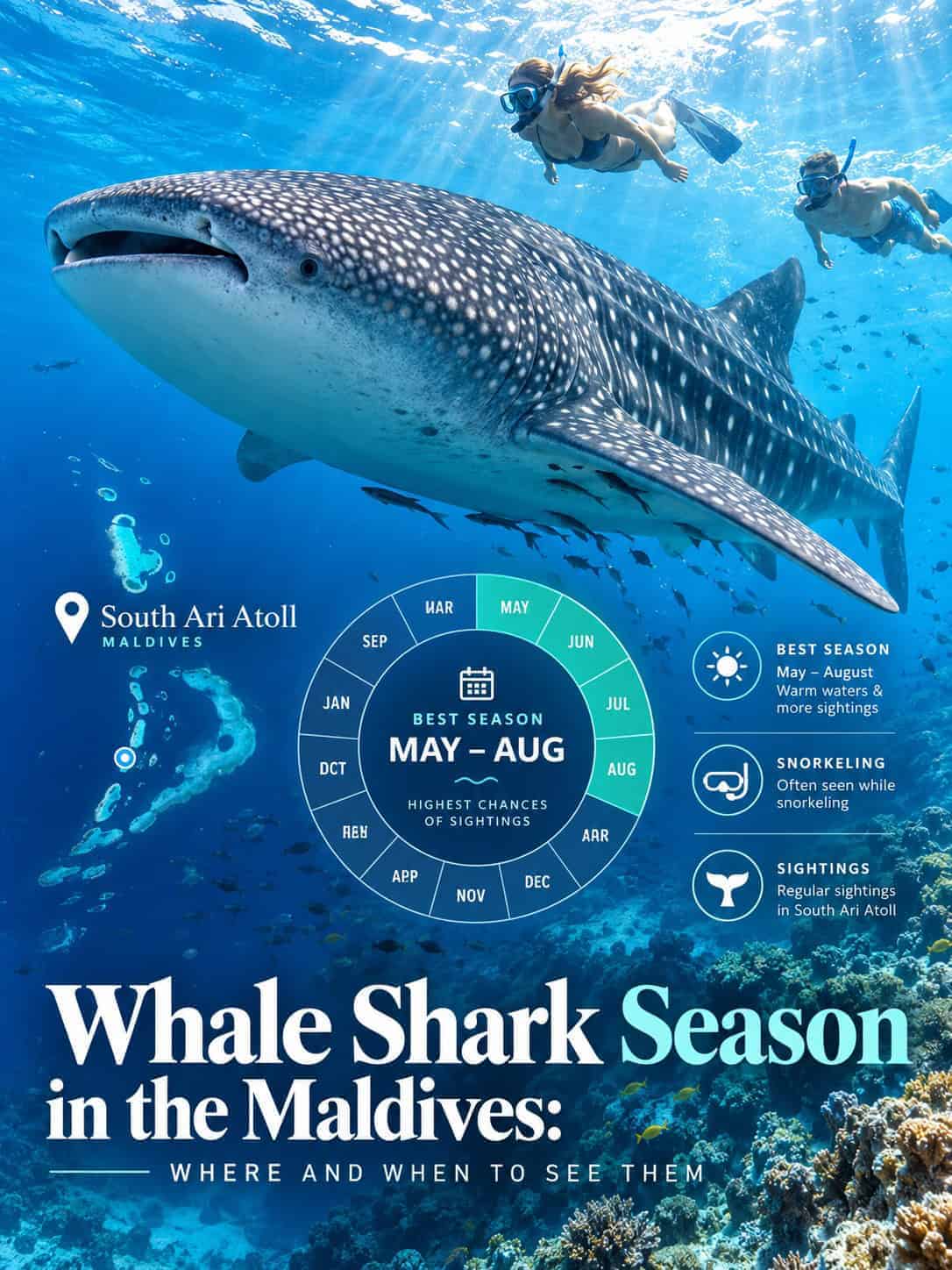
Whale sharks in the Maldives aren’t a seasonal gamble the way they are in a lot of other destinations — one specific stretch of reef sees them close to year-round. Understanding what the whale shark season in the Maldives actually runs on is less about picking the right month and more about picking the right place: the South Ari Marine Protected Area, where sightings happen in every month of the year, with real but modest swings in the odds rather than a hard on/off season.
Why the Maldives Has Such Reliable Whale Shark Sightings
Most whale shark destinations worldwide depend on a seasonal plankton bloom that draws the sharks in for a few weeks or months. The Maldives is unusual because the South Ari Marine Protected Area sits along a steep drop-off where deep, nutrient-rich water from the Indian Ocean regularly wells up against the atoll’s edge, feeding the plankton and small fish whale sharks filter-feed on almost continuously rather than seasonally. This is also why whale sharks here tend to be juveniles rather than adults — the area functions as a long-term feeding and nursery ground, not a migratory stopover.
Photo-identification shows how resident these sharks are: one individual has been recorded in the protected area more than 380 times over 14 years. Most are juvenile males, and sharks stop turning up here once they grow beyond about 8 meters, around the size at which they mature. Only about one encounter in six involves a shark feeding at the surface; the rest of the time they are cruising below it.
Where to actually find them: South Ari Marine Protected Area
The South Ari Marine Protected Area runs along the atoll’s southern rim, from the Rangali reef in the west to the far end of the Dhigurah reef in the east, with most encounters along the roughly 14 km of outer reef between Maamigili and Dhigurah, and it’s the single most reliable whale shark location in the entire country — resorts elsewhere in Ari Atoll run their whale shark trips down to this same stretch of water rather than searching locally. Dhigurah itself, a local island sitting right beside the protected area, has built much of its tourism economy specifically around same-day whale shark snorkeling trips, and several Ari Atoll resorts (Lily Beach Resort and Spa, Diamonds Thudufushi Maldives Resort & Spa, Nika Island Resort & Spa, Maldives) are options for a resort-based whale shark trip. Lily Beach and Diamonds Thudufushi are in South Ari, close enough to reach the zone in well under an hour by boat, while Nika is in North Ari Atoll, so a whale shark outing from there is a full-day trip south.
Whale Shark Season in the Maldives: When the Odds Shift
Sightings in the South Ari Marine Protected Area happen in every month of the year, but the odds aren’t perfectly flat. December through April, during the Maldives’ dry/northeast monsoon season, tends to bring calmer water and better visibility, which makes spotting a shark from the boat easier even when the underlying encounter rate doesn’t change much. May through November, the wetter southwest monsoon season, can bring choppier surface conditions and slightly lower visibility, but operators report whale sharks are still regularly seen through these months — it’s a visibility and comfort difference for snorkelers more than a true drop in shark activity. No month in the South Ari zone is considered a dead period.
The sharks also shift position with the monsoon. From December to April they are seen more often on the western part of the protected area, around Maamigili; from May to November they move east, toward Dhigurah. The largest numbers gather between August and November. For a guesthouse base on Dhigurah, that means the shortest boat rides in the wet season, while in the dry season the ride out can take up to about 45 minutes when the sharks are at the far end.
Where Else to See Whale Sharks in the Maldives
| Area | When | How you see them | Who it suits |
|---|---|---|---|
| South Ari Marine Protected Area | All year; largest numbers August-November | Snorkeling from a boat; scuba drift dives along the outer reef | Anyone comfortable swimming in open water; no certification needed to snorkel |
| Hanifaru Bay, Baa Atoll | Occasionally, during the May-November manta season | Guided snorkeling only; scuba is banned in the bay | Manta trips where a whale shark is a bonus, not the goal |
| Fuvahmulah | Mainly November-May, best December-March | Scuba diving on deep outer reefs, such as Farikede (30 m+) | Advanced divers; the sharks here are mostly large adult females, around 8 m long |
How a whale shark excursion actually works
Most trips are run as snorkeling excursions rather than scuba dives — whale sharks here usually cruise close enough to the surface to watch from above, so there’s no need for dive certification to see one. A typical trip involves a boat patrolling a stretch of the protected area with a spotter watching for a dorsal fin or shadow, then guests entering the water quickly and quietly once one is found; a strict code of conduct limits group size in the water and keeps a required distance from the animal, both to protect the sharks and to avoid scaring them off. Encounters typically last a few minutes to half an hour depending on how the shark behaves, and trips sometimes run multiple searches across a half-day outing if the first attempt doesn’t find one. If you’re also diving while in the area, see our guide to the best dive sites in the Maldives for what else South Ari Atoll has to offer.
Rules for Swimming With South Ari Whale Sharks
- Stay at least 3 meters from the shark’s head and body and 4 meters from its tail.
- Do not touch or ride the shark, block its path, swim on top of it or use flash photography.
- Enter the water ahead of the shark from the boat, never from the reef side, and keep noise down.
- Boats must be registered for the protected area, fit propeller guards and fly an authorized flag in the contact zone, and the guide must be a registered SAMPA guide.
- No more than six boats, including the rangers’ boat, may be within 250 meters of a sighting. They queue in the order they reported it, and no boat may drive at the shark.
Propeller strikes are the main source of injuries to whale sharks here, which is why the guards are compulsory and why a captain who races other boats to a sighting is one to avoid. For your own safety, the real requirement is swimming confidently in deep, open water with some current, because encounters happen off the outer reef rather than over a shallow lagoon. If you are not a strong swimmer, wear a flotation vest and stay close to the guide.
Realistic expectations: how likely is a sighting?
No operator can guarantee a whale shark sighting on any single trip — these are wild animals, not a managed attraction — but the South Ari Marine Protected Area has one of the highest success rates of any whale shark site in the world, with operators typically reporting sightings on roughly 70-90% of outings in any month. Multi-day trips or a resort stay of four or more nights near the protected area meaningfully improve the odds of at least one encounter compared to a single day trip squeezed into a longer itinerary elsewhere in the country.
Whale sharks vs. manta rays: different season, different place
It’s worth not confusing the two. Manta ray sightings in the Maldives are genuinely more seasonal and concentrated at specific cleaning stations, with Hanifaru Bay in Baa Atoll seeing its strongest aggregation roughly from May through November during plankton blooms tied to the southwest monsoon. Whale sharks in South Ari run on close to the opposite logic — a steady year-round presence rather than a seasonal bloom. A trip built around seeing both in one visit generally means splitting time between Ari Atoll and Baa Atoll, between May and November, when Hanifaru’s mantas are in season; August to October lines up the largest whale shark numbers in South Ari with Hanifaru’s June-October manta peak.
Booking a Whale Shark Excursion in the Maldives
Day trips from Dhigurah or from resorts in southern Ari Atoll are the most direct way to reach the South Ari Marine Protected Area, and most operators cap group sizes to keep both the water experience manageable and the impact on the sharks low — booking a day or two ahead during peak travel months (December-January, July-August) is a reasonable precaution rather than assuming a same-day spot will be available. Trips typically include snorkel gear, though it’s worth bringing a well-fitted mask if you have one, since encounters move quickly and a leaking mask can mean missing most of the window.
Whale Shark Trip Prices and What They Include
Guesthouse trips from Dhigurah are typically priced at around $70-90 per person for a half-day outing, while full-day trips with lunch cost more. Resort excursions in South Ari usually cost about $120-250 per person, depending on the resort and the length of the trip, and scuba dives with a whale shark chance are priced separately. The price normally covers the boat, a registered guide and snorkel gear; resort excursion prices are usually quoted before the 10% service charge and 17% tax.
Getting to South Ari for Whale Sharks
Lily Beach is a 20-25 minute seaplane flight from Velana International Airport and Diamonds Thudufushi 25-30 minutes. Seaplanes fly in daylight only, so a late international arrival means a night near the airport. Dhigurah is about 2 hours by shared speedboat, around $60 per person, with departures from the airport at 11:00 and 16:00 (10:00 and 16:15 on Fridays). The faster option is a 20-30 minute domestic flight to Maamigili followed by a short speedboat ride. Day trips from the Malé area do exist, but with roughly two hours on the boat each way, a stay of a few nights in South Ari gives far more time on the water and more chances of an encounter.
Frequently asked questions
What Is the Best Time of Year for Whale Shark Season in the Maldives?
Sightings happen year-round in the South Ari Marine Protected Area, though December through April tends to bring calmer water and better visibility for spotting them, while sightings continue through the wetter May-November months as well, when the largest numbers gather between August and November.
Where in the Maldives are whale sharks most commonly seen?
The South Ari Marine Protected Area, along the southern rim of South Ari Atoll between Maamigili and Dhigurah, is by far the most reliable location, and whale shark trips from elsewhere in Ari Atoll come to this same zone.
Do you need to be a certified diver to see whale sharks in the Maldives?
No — whale shark encounters in the South Ari Marine Protected Area happen while snorkeling near the surface, not on scuba dives, so no certification is required.
Can I see both whale sharks and manta rays on the same Maldives trip?
Yes, but they’re typically found in different places and seasons — whale sharks year-round in South Ari Atoll, and manta rays more seasonally at sites like Hanifaru Bay in Baa Atoll — so seeing both usually means visiting more than one area between May and November, when the Hanifaru manta season and year-round whale sharks overlap.