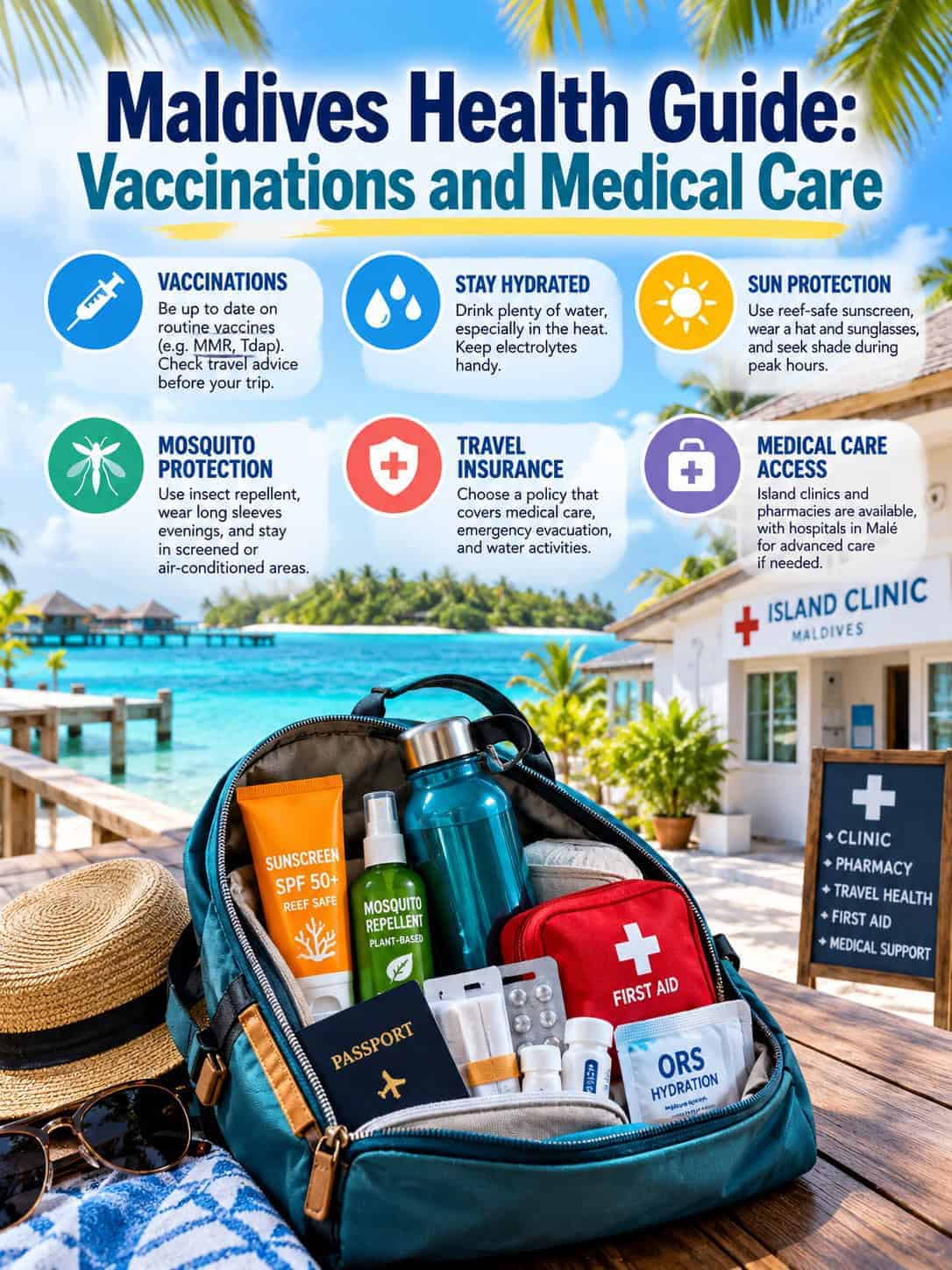
Quick answer: Most tourists do not need a vaccination certificate; a yellow fever certificate is required only after travel or transit through a risk country. CDC recommends hepatitis A, hepatitis B and typhoid vaccines for most travelers, and the Maldives reports dengue, chikungunya and measles, so prevent mosquito bites.
Do you need vaccines for Maldives travel? Most visitors do not need a mandatory vaccination certificate, but yellow fever rules apply after certain journeys through risk countries. The Maldives also reports dengue, chikungunya and measles. This guide compares vaccine recommendations, malaria risk, mosquito precautions and access to emergency medical care.
Do You Need Vaccines for Maldives Travel?
Most tourists do not need a vaccination certificate. Yellow fever certification is required for eligible travelers arriving from or transiting through a yellow-fever-risk country. CDC recommends hepatitis A and B vaccines for unvaccinated travelers and typhoid vaccination for most travelers. Check routine vaccinations, particularly MMR, before departure. These are medical recommendations, not universal entry requirements. Arrange a travel health consultation ideally at least four weeks before departure. Some vaccine schedules require more than one dose.
Maldives Vaccinations and Entry Requirements Compared
| Vaccine or disease | Requirement or recommendation | Who should check |
|---|---|---|
| Yellow fever | Certificate required after qualifying travel or transit through a risk country; not routinely recommended for Maldives itself | Travelers with relevant itineraries, including some long airport transits |
| Hepatitis A | Recommended for unvaccinated travelers aged 1+; special advice applies to infants | Unvaccinated visitors |
| Hepatitis B | Recommended for unvaccinated travelers of all ages | Unvaccinated visitors |
| Typhoid | Recommended for most travelers | Especially local-island and longer-stay visitors |
| Measles (MMR) | Keep routine vaccination up to date | All travelers, especially families |
| Dengue | Prevent mosquito bites; vaccination is not routine for all tourists | All visitors |
| Malaria | No malaria chemoprophylaxis normally advised for Maldives | Visitors arriving directly in Maldives |
Yellow fever certification depends on the itinerary, not nationality alone. Verify any transit through a yellow-fever-risk country before flying.
The age cutoff is not the same everywhere: Maldives Immigration exempts children under one year old, while CDC and UK health guidance apply the certificate rule from 9 months. If you are arriving from or through a risk country with a baby aged 9 to 12 months, carry the certificate so you meet the stricter rule.
Do You Need Vaccines for Maldives or Malaria Tablets?
No. The Maldives carries essentially no malaria risk, and standard travel health guidance lists no special malaria precautions needed for the country. This sets it apart from several of its South and Southeast Asian neighbors, where malaria prophylaxis is a real pre-trip consideration.
Maldives Diseases: Dengue and Mosquito Precautions
Dengue and chikungunya occur in the Maldives. Mosquitoes that spread these illnesses also bite during daytime hours, so do not rely on evening-only precautions. Use an effective insect repellent, wear covering clothing when practical and choose screened or air-conditioned rooms. Dengue vaccination is not routinely recommended for every short-term visitor; eligibility depends on individual history and medical advice.
Recent figures show why this matters. Dengue ran higher in 2026 than in the same period of previous years, with 2,969 cases reported across all atolls between January and 1 June. Measles is circulating too, with 144 confirmed cases in 2026, mostly in the Greater Malé area, so make sure everyone’s MMR doses are complete, including the early dose CDC advises for infants aged 6 to 11 months. Two travelers returning from the Maldives in 2026 were diagnosed with Zika, which can pass from a pregnant woman to her baby; pregnant travelers and couples trying to conceive should discuss the trip with a clinician first.
Is the Tap Water Safe to Drink?
Many resorts produce treated or desalinated water, but treatment alone does not guarantee every tap is suitable for drinking. Ask your accommodation whether its tap water is potable. If safety is uncertain, use sealed bottled or appropriately treated water, including for drinks and ice.
Is the Food Safe?
Food safety depends on storage, preparation and hygiene rather than whether a restaurant belongs to a resort. Choose thoroughly cooked meals served hot, wash hands before eating and avoid food that has been left unrefrigerated. Ask about allergens when ordering seafood or shared dishes.
What Happens If I Get Seriously Sick on a Remote Island?
Medical capacity varies across islands. Major hospitals are concentrated in Malé and Hulhumalé, while specialist treatment may require a boat or air transfer. Before booking a remote stay, ask how emergencies are transported and whether a clinician is available on site. Some resorts offer an on-site doctor or clinic, but staffing and emergency equipment vary by property. Confirm medical coverage directly with your accommodation, especially when traveling with children or managing a chronic condition. Suspected diving-related decompression illness needs urgent specialist assessment. Before diving, confirm the operator’s emergency oxygen, evacuation plan and access to hyperbaric treatment. This is part of the broader risk picture covered in our look at how safe the Maldives actually is.
What happens next depends on where you are staying. On a resort island, call reception first: the resort’s doctor or nurse, where there is one, gives first treatment, and the resort arranges the speedboat or seaplane to Malé. Seaplanes fly only in daylight, which is one reason resorts within speedboat range of Malé offer the shorter path to a hospital at night. On a local island, go to the island health center, which sends serious cases on by boat to a larger hospital, usually in Malé or Hulhumalé. In both cases, call your insurer’s emergency line as soon as you are referred for treatment or transfer. For divers, ADK Hospital in Malé has a hyperbaric treatment unit, and Bandos, Kuramathi, Kuredu and Kandima resorts run their own recompression chambers.
Do You Need Vaccines for Maldives and Medical Insurance?
Vaccines are covered above; insurance is the bigger practical question, and the reason it matters is cost rather than likelihood: medical treatment in the Maldives, especially anything requiring evacuation from a remote resort island, can be expensive, and standard health coverage from most home countries won’t apply here. Comprehensive travel insurance that explicitly covers medical evacuation, and diving-specific coverage if diving is part of the trip, is worth confirming before departure rather than assuming a generic policy has it handled.
What About Sun and Heat?
This is the health risk most travelers actually underestimate. Severe sunburn is a real and common issue, driven mostly by travelers spending far more consecutive hours in direct sun than they’re used to at home, on beaches and boats with no shade and plenty of reflected light off the water. High-SPF sunscreen, reapplied regularly, a hat, and genuinely pacing beach time in the first few days before the skin adjusts are the simplest, most effective precautions on this entire list, more relevant day to day than any of the vaccine questions above.
Can I Bring My Prescription Medications?
Yes, but with one important caveat: the Maldives has strict rules around certain medications, including some common painkillers and sedatives that are freely available elsewhere but classified as controlled substances locally. Travelers on regular prescriptions should carry medication in its original, labeled packaging along with a copy of the prescription or a doctor’s letter, and bring no more than the prescribed dosage covers for the length of the stay. Medicines are regulated by the Maldives Food and Drug Authority, and controlled drugs brought in for personal use need a valid prescription from a registered medical practitioner. Declare anything you are unsure about at customs on arrival rather than leaving it undeclared in your bag.
What Should Actually Be in a Travel Medical Kit?
Given the specific risk profile here, water and sun matter more than most generic packing lists suggest: high-SPF reef-safe sunscreen, insect repellent for dengue prevention, rehydration salts, basic diarrhea and motion-sickness medication, any personal prescriptions in original packaging, and a small supply of seasickness medication if island-hopping or excursion boats are part of the plan. A basic first-aid kit covers the rest, cuts from reef coral are common enough among snorkelers that antiseptic and bandages are worth having on hand rather than relying entirely on resort first aid for something minor. For the rest of the packing list beyond the medical kit, see our full guide on what to pack for the Maldives.
Emergency number: Dial 102 for an ambulance in the Maldives. Share your island, resort or guesthouse name and the nearest reachable jetty. For remote-island emergencies, tell your insurer and accommodation immediately because transport arrangements may affect access to treatment.
Maldives Diseases: When to Seek Medical Care
| Symptoms or situation | Recommended action |
|---|---|
| Fever after mosquito exposure | Seek medical assessment promptly and mention recent travel; dengue and other infections may require testing |
| Breathing difficulty, severe allergic reaction or confusion | Emergency care; call 102 |
| Severe dehydration or inability to keep fluids down | Seek urgent medical advice |
| Symptoms after diving | Stop diving and obtain urgent specialist help; contact the dive operator’s emergency team |
| Deep coral injury or worsening wound | Clean the wound and seek assessment for infection and tetanus protection |
Any Extra Precautions for Kids or Older Travelers?
The main adjustments are heat and sun management rather than anything Maldives-specific: children and older travelers dehydrate and sunburn faster, so shorter, more frequent breaks from direct sun and a stricter sunscreen reapplication schedule matter more than for a fit adult traveler. Resorts marketed as family-friendly, such as Niva Kurumba Maldives (5-star, luxury) or Machchafushi Island Resort, The Centara Collection (5-star, luxury), generally have more robust on-site medical staffing and kids’ programming with built-in shade and supervised swim areas than smaller adults-only boutique properties, worth factoring in specifically for families with very young children or travelers with existing health conditions who want a shorter path to medical support if something comes up, something to keep in mind while building out a Maldives family itinerary.
The gap between those two is mostly distance. Niva Kurumba has an in-house doctor and nurse and is a 10-minute speedboat ride from the airport, with the Malé-area hospitals close by; Machchafushi sits in South Ari Atoll, about 25 minutes from Malé by seaplane, so any hospital transfer starts with a flight.
Do You Need Vaccines for Maldives? Frequently Asked Questions
Are vaccines mandatory for Maldives entry?
Most tourists need no vaccination certificate. Yellow fever proof may be required if your itinerary includes a country with yellow fever transmission risk.
Do You Need Vaccines for Maldives After a Long Airport Transit?
Yes. A transit of more than 12 hours through an airport in a yellow-fever-risk country can trigger the certificate requirement.
Is malaria present in the Maldives?
Malaria prevention tablets are not normally recommended for travel confined to the Maldives.
Can tourists get dengue in the Maldives?
Yes. Dengue occurs in the Maldives; reduce mosquito exposure during both daytime and evening hours.
Do You Need Vaccines for Maldives With Children?
Review routine MMR protection and recommendations for hepatitis A, hepatitis B and typhoid with a travel health clinician.
What is the ambulance number in the Maldives?
Dial 102. On remote islands, ask the resort or guesthouse to coordinate transport while emergency care is arranged.
Can medical treatment require evacuation?
Yes. Specialist facilities are concentrated in Malé and Hulhumalé, and remote islands may need boat or air transfer.
Do You Need Vaccines for Maldives or Special Dive Insurance?
Check that the policy explicitly covers scuba diving, emergency evacuation and hyperbaric treatment where applicable.
Before you travel, a Maldives eSIM makes it easier to reach clinics and your insurer, and you can compare flights to Malé once your dates are set.