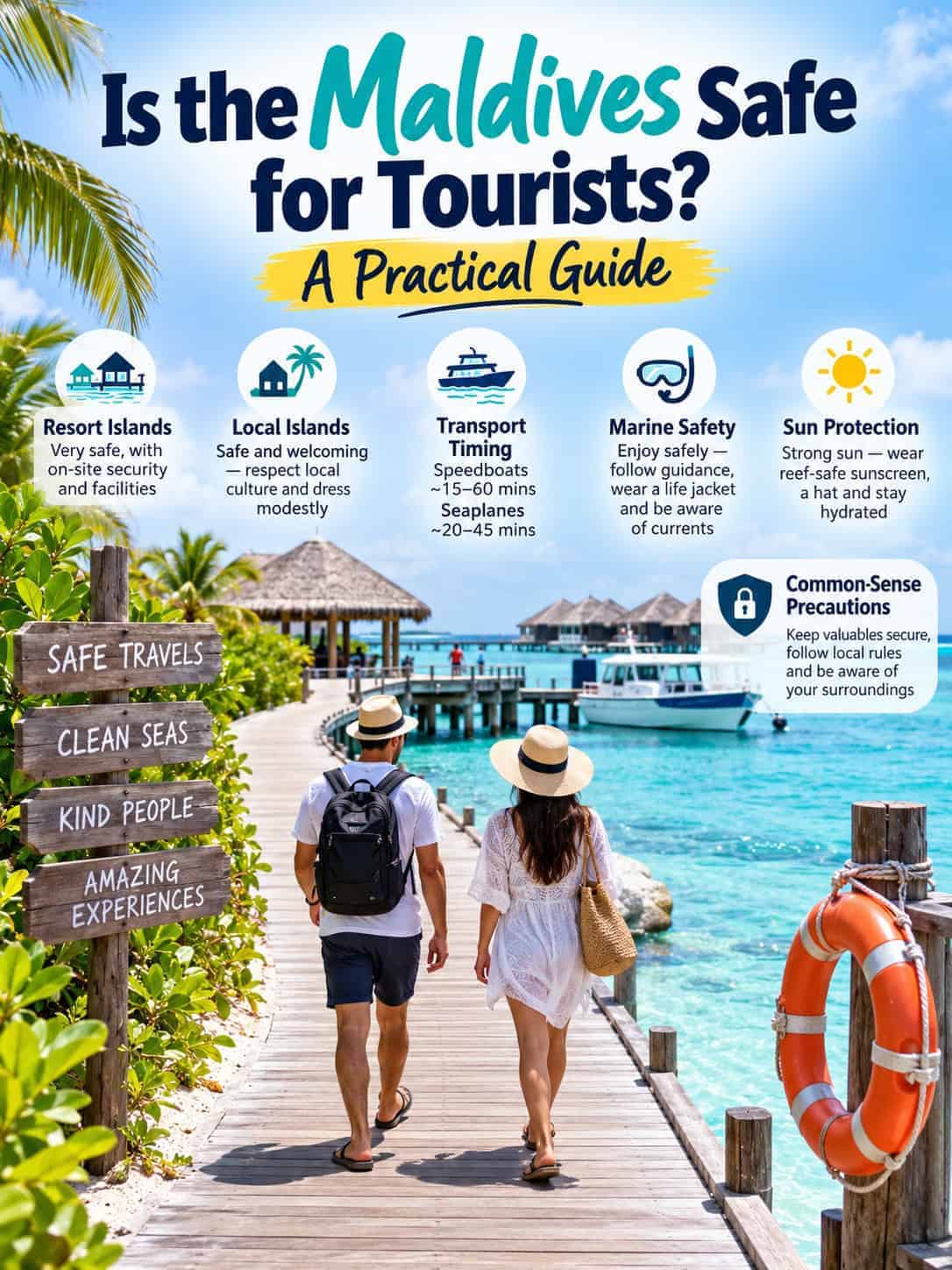
Is Maldives safe for tourists? The country has low crime on resort islands, but official travel advisories recommend increased caution. Strong currents, boat accidents, limited healthcare on remote islands and security concerns deserve planning. This guide compares risks and explains what to check before booking.
Is Maldives Safe for Swimming and Snorkeling?
Strong tidal currents can pull swimmers away from shore, even when water appears calm. Fatal drownings have occurred. Do not treat lagoon depth or clear visibility as proof of safe conditions. Ask resort staff about currents and designated swimming areas before entering the water. Swim only in areas your resort marks as safe or supervised, ask staff about local current conditions before heading out on your own, and treat “it looks calm” as unreliable information near any channel or reef edge.
Is Maldives Safe for Boat and Wildlife Excursions?
Fatal boat propeller accidents have occurred in popular snorkeling and whale shark areas, including the South Ari Marine Protected Area, where propeller guard rules exist but aren’t yet fully enforced across every operator. This risk is specific to excursion boats in high-traffic wildlife-viewing zones rather than a general Maldives hazard, but it’s serious enough to actively check before booking a whale shark or snorkel excursion: ask whether the boat uses propeller guards and whether the operator follows marked entry and exit zones for swimmers.
Is Maldives Safe for Scuba Diving?
The Maldives has excellent diving, but many resort islands sit more than an hour from the nearest hyperbaric chamber, because recompression chambers are scarce: there is one at ADK Hospital in Malé and a few on resort islands. This isn’t a reason to avoid diving, but it is a reason to ask your dive operator directly how they’d get you to a chamber in an emergency, and to make sure your travel insurance explicitly covers diving-related medical evacuation before you book a liveaboard or dive-focused stay.
Maldives Travel Safety During Heavy Rain
Heavy rain can cause flash flooding on low-lying islands and disrupt transfers. Follow local weather alerts and boat operator instructions. Allow flexibility when connecting domestic flights, seaplanes and international departures.
Is Maldives Safe on Resort and Local Islands?
Resort islands run as closed, controlled environments with genuinely low crime levels; petty theft happens occasionally, so don’t leave valuables unattended on the beach or in an unlocked room, but violent crime against tourists on resort islands is rare. A five-star property like Baros Maldives (5-star, ultra-luxury) or a mid-range island like Kandooma Maldives (4-star, mid-range, formerly Holiday Inn Kandooma) both operate within that same controlled-access model. The picture changes somewhat on populated local islands, particularly in Malé and Hulhumalé, where gang-related violence, including knife crime, does occur, generally not targeting tourists specifically but still worth factoring in: avoid walking empty roads after dark in the capital, the same basic precaution that applies in most mid-sized cities anywhere. That gap is really a difference between two kinds of Maldives trip; see our comparison of a resort island versus a local island for how much the day-to-day experience actually changes.
Maldives Travel Advisory: Protests and Unrest
Protests occur occasionally in Malé, tied to domestic Maldivian politics rather than anything directed at foreign visitors. They’re rare on a given trip and simple to avoid: steer clear of any visible gathering or rally rather than walking through out of curiosity, and check local news if traveling during a period of known political tension.
Local Laws That Can Get Visitors in Trouble
Some Maldivian laws carry far heavier penalties than visitors expect. Drug offenses are treated with zero tolerance, with long prison terms and the death penalty for the most serious cases. Same-sex relations are illegal and can bring a fine or a prison sentence. Vapes and e-cigarettes are banned for tourists too: importing them has been illegal since November 15, 2024, and possessing or using them since December 15, 2024, so leave them at home rather than hand them over at customs.
Maldives Travel Warning: Terrorism Risk
Terrorist attacks can’t be entirely ruled out in the Maldives, and recent years have included isolated incidents: a foiled plot in 2025, a knife attack on a politician in Hulhumalé in 2022, an IED attack in central Malé in 2021, and knife attacks on three foreign tourists in Hulhumalé in 2020. These are genuinely rare events relative to the millions of tourist visits the Maldives receives, but they’re real enough that staying aware of local news and following any official guidance during your stay is sensible, the same baseline awareness worth applying almost anywhere in the world now.
The United States assigns the Maldives Level 2 (Exercise Increased Caution) due to terrorism, in advice issued on October 7, 2025. Canada and Australia also recommend a high degree of caution, with Canada citing the threat of terrorism. The UK does not advise against travel to any part of the country. Official advisory levels describe security concerns, not the probability of an incident during an individual trip.
Is Maldives Safe? Practical Safety Summary
Maldives travel safety depends on the island, activities and local conditions. Resort-island crime is generally low, but water safety needs active precautions. Government advisories also identify terrorism concerns. Avoid demonstrations and check evacuation arrangements for remote accommodation. The practical answer to “is Maldives safe” is conditional: choose supervised swimming areas, vetted excursion operators and appropriate medical insurance. Check current government advice before departure.
Is Maldives Safe for Solo Female Travelers?
Resort-based solo travel for women is generally straightforward in the Maldives; the closed-resort model that makes crime rare for all guests applies equally regardless of who’s traveling alone. Local island travel calls for the same precautions outlined above, avoiding empty roads at night in Malé and Hulhumalé specifically, plus awareness that dress norms are more conservative on inhabited local islands than on a resort’s private beach, which is as much about cultural respect and comfort as about safety. Solo female divers and snorkelers should apply the same current and boat-safety awareness as any other traveler; none of the top risks on this list are gendered.
Maldives Travel Safety: Resort vs Local Island
| Issue | Resort island | Inhabited island / Malé |
|---|---|---|
| Crime | Generally low; secure valuables | More urban precautions, especially after dark |
| Swimming | Use designated safe areas; ask about currents | Confirm approved swimming areas and boat traffic |
| Alcohol | Available in licensed resort settings | Possession and consumption restrictions apply |
| Clothing | Resort dress rules apply; topless bathing prohibited | Conservative dress outside designated tourist beaches |
| Medical assistance | Ask about clinic and evacuation arrangements | Facilities vary; Malé has major hospitals |
What Travel Insurance Should Actually Cover
Given where the real risks sit, water-related evacuation and diving-specific medical coverage matter more for a Maldives trip than the general trip-cancellation coverage most travelers default to. Policies worth considering should explicitly cover emergency medical evacuation by boat or seaplane from a remote resort island, hyperbaric chamber treatment if diving is on the itinerary, and medical treatment costs generally, since most resort islands have no hospital and serious cases require transfer to Malé or an international medical evacuation. Confirming these specifics before departure is a more useful exercise than assuming a generic travel policy has it covered, and it pairs well with checking our broader Maldives health guide for vaccinations and other preparation.
Maldives Travel Safety: Insurance Questions Before Booking
- Does the policy cover snorkeling, diving depth limits and boat excursions?
- Does medical evacuation cover speedboat or aircraft transfers between islands?
- Are search and rescue, hyperbaric treatment and pre-existing conditions excluded?
- Does the provider require preauthorization before medical transport?
- What is the deductible and emergency contact number?
Medical treatment may require transfer to Malé. U.S. travel advice identifies ADK Hospital, Tree Top Hospital and Indira Gandhi Memorial Hospital among the major facilities in the Malé area. Travelers should verify evacuation, advance-payment and diving coverage before departure.
Is Maldives Safe in a Medical Emergency?
Most mid-range and larger resorts have a standard protocol for medical or safety incidents: on-site first aid or a small clinic for minor issues, a relationship with a speedboat or seaplane operator for faster transfers when needed, and an established path to Malé’s main hospitals or a medical evacuation service for anything serious. Smaller guesthouses and budget properties on local islands typically rely more directly on that island’s own health center and the standard inter-island transport network rather than a dedicated in-house medical setup. Asking a resort directly about its emergency protocol before booking, particularly for a remote outer-atoll property, is a reasonable question that any established resort should be able to answer clearly and specifically. Getting the more routine paperwork sorted in advance, covered in our Maldives visa guide, is one less thing to worry about if something does go wrong.
Distance matters most at night. Seaplanes fly only in daylight, while resorts a short speedboat ride from Malé, some of which run transfers around the clock, can get a patient to the capital’s hospitals at any hour. If someone in your party is pregnant or has an existing medical condition, that is a solid reason to choose a resort in North or South Malé Atoll over a seaplane-only island.
Maldives Emergency Contacts
| Service | Number |
|---|---|
| General police emergency | 911 (Maldives Police Service) |
| Police | 119 |
| Fire and rescue | 118 |
| Tourist Police, 24/7 | +960 979 0070 |
| Tourist Police hotline | 1478 |
| Ambulance | 102 |
| Indira Gandhi Memorial Hospital (IGMH), Malé | +960 333 5335 |
| ADK Hospital, Malé | +960 331 3553 |
| Tree Top Hospital | +960 335 1610 |
| Hulhumalé Hospital | +960 335 0037 |
For urgent incidents at a resort, alert reception or the boat crew immediately. For an ambulance, dial 102. The 24/7 Tourist Police line also answers on WhatsApp, Viber and Telegram, which helps when you only have a data eSIM, and the Tourist Police handle disputes and fraud complaints against tourism operators, such as a booking or excursion scam.
Frequently Asked Questions About Maldives Travel Safety
Is Maldives safe for families with children?
Families should check supervised swimming areas, child-sized life jackets and access to medical care. Strong currents may exist near shallow reefs.
Is Maldives safe at night?
Resort islands generally report low crime. In Malé and Hulhumalé, avoid deserted streets after dark.
What does the Maldives travel advisory say?
The United States lists Level 2 due to terrorism. Other countries advise increased caution; check guidance for your nationality.
Is snorkeling safe in the Maldives?
Conditions vary by beach and day. Check current warnings and use a flotation aid if needed.
Are boat trips safe in the Maldives?
Ask about life jackets, licensing, propeller guards and safe swimmer entry points.
Can I drink alcohol on local islands?
Do not carry or drink alcohol outside permitted resort settings.
What should diving insurance cover?
Confirm hyperbaric treatment, evacuation and the relevant diving activity before departure.
Who can tourists call in an emergency?
Dial 911 for police, 102 for an ambulance and 118 for fire; the 24/7 Tourist Police line is +960 979 0070.
For a smoother arrival, airport transfers in Malé can be booked in advance, and a Maldives eSIM keeps you connected for maps and emergency contacts.