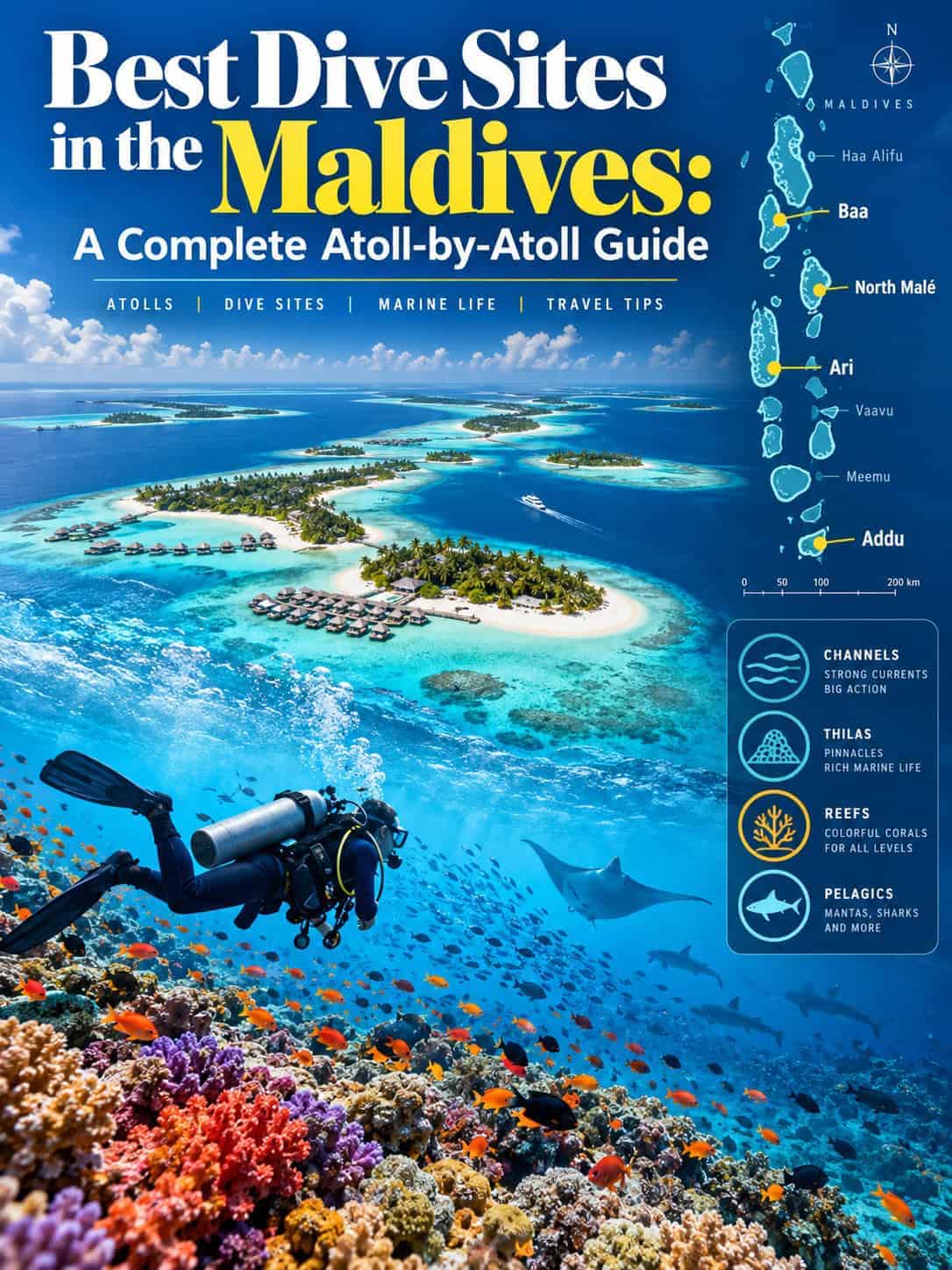
Scuba diving Maldives trips work best when you choose sites by atoll, currents and the marine life you hope to see. Sharks cluster in the deep south, mantas work a handful of named cleaning stations, and the classic kandus and thilas of the central atolls reward anyone comfortable with current. Fuvahmulah diving in the far south, Ari Atoll nights and Malé Atoll reefs are all covered below, and the sites are grouped by atoll for a reason: which ones belong on your list depends entirely on where you’re actually staying.
Scuba Diving Maldives: North and South Malé Atolls
Most Maldives trips start in North or South Malé Atoll simply because of the airport, and the diving here holds up fine without a long transfer. Banana Reef, one of the country’s original named dive sites, runs from about 5 to 30 meters and is known for caves and overhangs along the reef wall — an easy, current-light introduction to Maldivian reef diving. Kandooma Thila in South Malé Atoll is the opposite: a current-swept pinnacle with its top at about 12 meters and a drop to roughly 40, where sharks and eagle rays gather when the current runs, and it’s a genuine thila dive rather than a gentle reef swim. North Malé also has manta cleaning stations (covered in more depth in our manta ray diving guide), with mantas generally easier to find from roughly May to November.
Scuba Diving Maldives: Ari Atoll and Night Dives
Ari Atoll’s size means it has more named sites than any other atoll, and two in particular keep coming up. Mushimasmingili Thila — better known as Fish Head or Shark Point — is a marine protected area in North Ari where the reef drops to about 35 to 40 meters and resident gray reef sharks patrol, with up to about 16 counted on a single dive. Maaya Thila, in North Ari, is a pinnacle from about 6 to 30 meters famous for night dives, when whitetip reef sharks and giant trevally come out to hunt. Ari Atoll also neighbors Rasdhoo, where the hammerhead dive described below is a short boat ride away for anyone staying on this side of the country.
Scuba Diving Maldives: Rasdhoo Hammerhead Dives
Hammerhead sightings at Rasdhoo’s Madivaru Corner are possible but not guaranteed; the dive leaves around dawn, the main season is roughly January to April, and sometimes only single animals or small groups show up. This advanced blue-water dive depends on conditions and local operator guidance. It’s a serious dive: strong currents, open-water conditions with nothing to hold onto, and a timing window that doesn’t forgive a late start. Dive centers generally want intermediate-to-advanced certification and real comfort in blue water before booking anyone onto this one.
Vaavu Channel Dives
For scuba diving Maldives travelers, Vaavu doesn’t get the same attention as Ari or the deep south, which is partly why its kandus stay relatively uncrowded. Miyaru Kandu, in the atoll’s Felidhoo area, is a channel nicknamed Shark Channel in northern Vaavu, known for gray reef sharks, dogtooth tuna and eagle rays, with hammerheads only occasional visitors — it rewards exactly the kind of drift diving in the Maldives that channel sites are built for, where you stop kicking and let the current carry you along the wall. Vattaru Reef is a channel and wall dive with currents of about one to two knots, an average depth near 20 meters and a wall that drops past 40, with whitetip reef sharks, Napoleon wrasse and eagle rays. Neither site is beginner territory; both assume you can manage a real current without panicking.
Fuvahmulah Diving: Scuba Diving Maldives in the South
If there’s one region in the Maldives built entirely around shark diving, it’s the deep south. Fuvahmulah, a single standalone atoll far south of the main chain, has two sites that draw divers from everywhere: Tiger Harbour (formerly Tiger Zoo), where the harbor entrance sits at about 10 meters with a drop-off to 65 and more than 15 tiger sharks can gather, and The Plateau, an advanced dive (reef top at about 15 meters, maximum about 30, real current) that adds scalloped hammerheads, oceanic mantas, and occasional whale sharks to the tiger shark lineup. Further north in Laamu Atoll, Hithadhoo Corner is a manta cleaning station with mantas year-round (peaks around October–November and April–May) that works for less experienced divers, while Fushi Kandu brings resident gray reef sharks, barracuda and big-eye jacks into current-exposed water nearby. Fuvahmulah diving takes a dedicated trip — it’s not a side excursion from a North Malé resort — but it’s where the Maldives’ shark diving reputation actually comes from.
Fuvahmulah has no boat leg: the airport sits on the island, and dive centers are a short drive from it. Coming from Addu, a Twin Otter hop takes about 20 minutes, or the public ferry takes 45-90 minutes depending on the sea (no ferries on Fridays). Tiger Harbour is open to Open Water divers, because the dive stays near the 10-meter harbor mouth, and so is Thoodu, the north reef, where thresher sharks show up year-round. The Plateau, which local dive maps call Farikede, needs Advanced certification, and its thresher, oceanic manta and whale shark season runs from November to May. Hammerheads appear mostly around the new and full moon, and visibility drops to about 15-20 meters from June to September, against 30-40 meters for most of the year.
Scuba Diving Maldives: When to Visit
The country’s dive calendar splits along the same monsoon line that drives its manta seasons. The northeast monsoon, roughly December through April, tends to bring calmer seas and good visibility, especially on the eastern sides of the atolls. The southwest monsoon, May through November, brings more plankton and lower visibility, and with it more feeding mantas and whale sharks. Neither season is objectively better; they’re suited to different goals, which is exactly why Fuvahmulah diving and other site-specific trips, like any trip planned around specific marine life, should check the season for that site, not just the general Maldives weather calendar.
Drift Diving Essentials
For scuba diving Maldives drift sites, a large share of the sites above — Kandooma Thila, Miyaru Kandu, Madivaru Corner, The Plateau — are current-driven dives where the standard approach is to drop in, get neutrally buoyant, and drift rather than swim against the water. If that’s new, it’s worth saying plainly before booking: Maldives drift diving requires suitable experience, professional supervision and careful assessment of currents. Most operators will ask about logged dives and comfort level before putting anyone on the current-heavy sites, and it’s worth being honest about that rather than finding out mid-dive.
Certification, Depth Limits and Dive Costs
Maldivian rules cap recreational diving at 30 meters, so the deep figures in this guide, such as the 65-meter drop-off at Tiger Harbour or walls past 40 meters, describe the reef rather than your dive plan. An Open Water card covers dives to 18 meters, which is enough for Banana Reef, Tiger Harbour and most house reefs. Advanced Open Water takes you to 30 meters and is what dive centers ask for on Kandooma Thila, Fish Head, Madivaru Corner, Miyaru Kandu and The Plateau. Most boats also expect every diver to wear a personal dive computer, and resort dive centers rent them by the dive.
Dive Sites at a Glance
| Site | Atoll | Depth | Minimum level | Best time |
|---|---|---|---|---|
| Banana Reef | North Malé | 5–30 m | Open Water | Year-round |
| Kandooma Thila | South Malé | Top about 12 m, drop to about 40 m | Advanced, strong current | Year-round |
| Fish Head (Mushimasmingili Thila) | North Ari | 8–40 m | Advanced, current expected | Year-round |
| Maaya Thila | North Ari | 6–30 m | Intermediate | Year-round; night dives; clearest water December–April |
| Madivaru Corner | Rasdhoo | From about 20 m into open blue | Advanced Open Water | January–April, dawn departure |
| Miyaru Kandu | Vaavu | 15–40 m+ | Advanced | Year-round |
| Tiger Harbour | Fuvahmulah | About 10 m | Open Water | Year-round; clearest water December–April |
| Thoodu (north reef) | Fuvahmulah | Reef top about 5 m | Open Water | Threshers year-round |
| The Plateau (Farikede) | Fuvahmulah | Reef top about 15 m | Advanced | November–May for threshers, oceanic mantas and whale sharks |
| Hithadhoo Corner | Laamu | 8–25 m | All levels, moderate current | Mantas year-round; peaks October–November and April–May |
Fun-dive prices depend on where you dive. On Rasdhoo, local-island dive centers charge about $60 per boat dive plus $5 for equipment, or $69 with full gear. Resort dive centers price higher and itemize more: at Kuredu in Lhaviyani Atoll a single dive costs $84 for tank and weights, the boat adds $29 and each piece of rental gear $9, with tax and service included; Kudafushi in Raa Atoll lists a boat dive at $60 including the boat, gear at $30 per dive, and 10% service plus 17% GST on top. Packages of five to six dives or more bring the per-dive price down at all of them. Liveaboards cost about $1,800-5,000 per person for a week, depending on the boat and route, usually with three or four dives a day.
Dive Safety: Chambers and Flying After Diving
Recompression facilities are limited: ADK Hospital in Malé runs a hyperbaric unit, and a few resorts, including Bandos in North Malé Atoll and Kuramathi in Rasdhoo Atoll, have a chamber on the island. From the deep south or a remote atoll, reaching one means a boat ride or a flight, so ask your dive center about its emergency plan and make sure your insurance covers chamber treatment and evacuation. Seaplanes and domestic flights count as flying: the Divers Alert Network guideline is at least 12 hours after a single dive and 18 hours after multiple dives or several days of diving, so plan your last dive for the day before the transfer back to Malé, not that morning.
Where to Stay for Diving
Scuba diving Maldives logistics start with the atoll: basing a trip near the right one saves hours of transfer time better spent diving. For North and South Malé Atoll sites, Niva Kurumba Maldives and Taj Exotica Resort & Spa both run dive boats to Banana Reef and Kandooma Thila without a long crossing. On Ari Atoll, Niva Kuramathi Maldives sits close to both Mushimasmingili Thila and Maaya Thila. Divers set on the Rasdhoo hammerhead dive often stay on nearby guesthouse islands rather than a resort, to cut the pre-dawn boat ride short. For the deep south, accommodation is genuinely limited — Fuvahmulah itself runs mostly on local-island guesthouses rather than resorts, and that’s worth planning around rather than discovering on arrival; check accommodation options on the island directly before booking flights, since the choice is narrower than in the central atolls. You can compare flights to Malé, book airport transfers in advance, and see our domestic flights guide for the onward leg; the best time to visit the Maldives guide helps with timing, and dive trips and day excursions can be compared and booked in advance.
Getting to Each Dive Area From Malé
| Dive area | Example base | Transfer from Velana Airport |
|---|---|---|
| North and South Malé (Banana Reef, Kandooma Thila) | Niva Kurumba, Taj Exotica | Speedboat, about 10 min to Niva Kurumba, 15–20 min to Taj Exotica |
| North Ari and Rasdhoo Atoll (Fish Head, Maaya Thila) | Niva Kuramathi | Seaplane about 20 min, or speedboat 75–90 min |
| Rasdhoo island (Madivaru Corner) | Local guesthouses | Shared speedboat about 1 hour 10 minutes, departures around 10:30 a.m. and 4 p.m. |
| Vaavu (Miyaru Kandu) | NOOE Maldives Kunaavashi | Speedboat about 75 min, or seaplane about 25 min |
| Laamu (Hithadhoo Corner, Fushi Kandu) | Six Senses Laamu | Seaplane about 65 min, or domestic flight to Kadhdhoo about 50 min plus speedboat |
| Fuvahmulah (Tiger Harbour, The Plateau) | Local guesthouses | Domestic flight; the airport is on the island |
Seaplanes fly in daylight only, so if your international flight lands late in the afternoon, plan a night near the airport before an Ari, Vaavu or Laamu seaplane.
Frequently Asked Questions
Which site is best for maldives diving? There isn’t one universal answer — it depends on what you want to see. Fuvahmulah’s Tiger Harbour is unmatched for tiger sharks, Rasdhoo’s Madivaru Corner is the most reliable hammerhead dive, and Maaya Thila in Ari Atoll is one of the best-known night dives in the country.
When is the best diving season in the Maldives? The northeast monsoon, December through April, generally brings calmer water and better visibility. The southwest monsoon, May through November, brings more current and more pelagic action like feeding mantas and whale sharks. Which is “better” depends on what you’re diving for.
Does fuvahmulah diving require advanced certification? Not for Tiger Harbour or Thoodu, the north reef: Fuvahmulah dive centers take Open Water divers on both. The Plateau is the exception, an advanced dive with real current. Elsewhere, places like Banana Reef or Hithadhoo Corner are manageable for less experienced divers. But many of the Maldives’ signature sites (Madivaru Corner, The Plateau, Kandooma Thila, Miyaru Kandu) involve real current and are generally restricted to intermediate or advanced divers by the dive centers running them.
Can beginners still have a good diving trip in the Maldives? Yes. North and South Malé Atoll have calmer, shallower reef sites suited to newer divers, and many resorts run introductory dives and certification courses on-site. The current-heavy shark and hammerhead sites simply aren’t part of that itinerary until the logged dives add up.
Maldives Diving in Numbers
| Fact | Number |
|---|---|
| Atolls | 26 natural atolls spread across roughly 871 km |
| Water temperature | About 27–30 °C all year |
| Visibility | Roughly 10–40 m, usually best on the eastern sides in the northeast monsoon |
| Fuvahmulah Tiger Harbour | Entrance about 10 m, drop-off to 65 m, 15+ tiger sharks at once |
| Fuvahmulah Plateau | Reef top about 15 m, maximum about 30 m, advanced level |
| Flight from Malé to Fuvahmulah | About 80–90 minutes |
| Hanifaru Bay (Baa Atoll) | Snorkeling only, maximum 5 boats and 80 visitors at once, certified guide required, a small entry fee that varies |
| Rasdhoo public ferry from Malé | Public ferry about 3 hours and a few dollars, a few mornings a week and never on Fridays; shared speedboat about 1 hour 10 minutes, about $49 each way |
| A single shark dive | Typically around $100–150 including boat and gear |