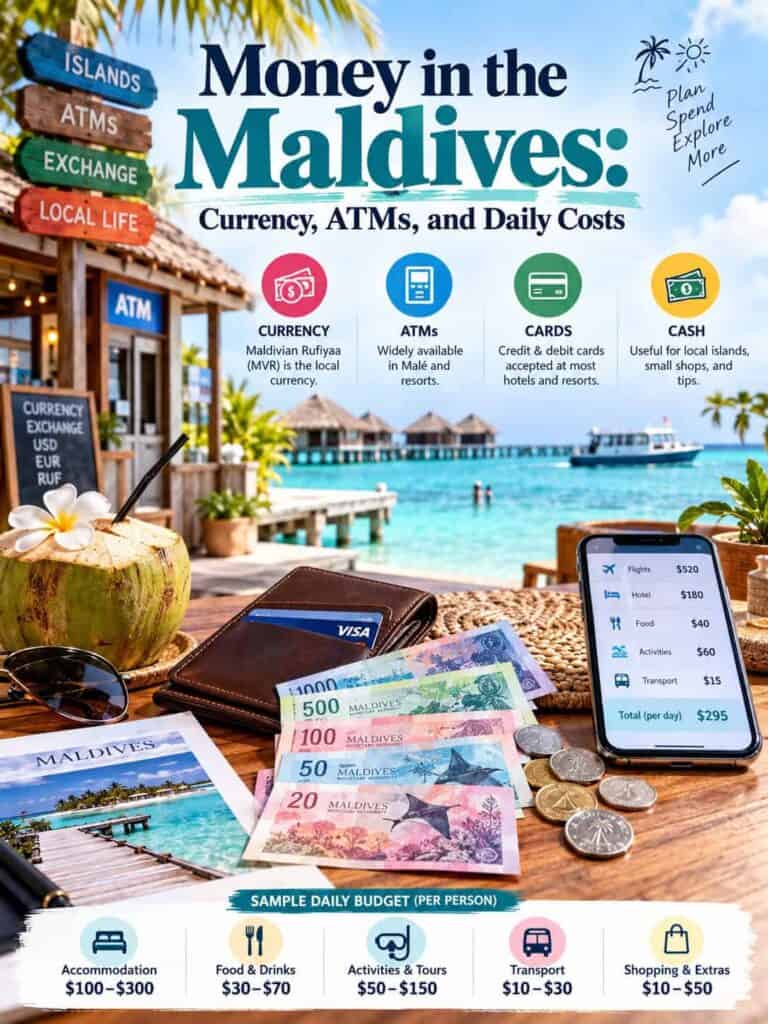
Quick answer: the currency of the Maldives is the Maldivian rufiyaa (code MVR, written Rf). Tourists, however, mostly pay in US dollars: resorts price and bill in USD, and USD cash is widely accepted even in Malé and on local islands. The official rate is close to 15.4 rufiyaa per US dollar. At the official rate of 15.42 rufiyaa per dollar, 100 USD is about 1,542 MVR and 100 MVR is about 6.49 USD. Exchange rates can change, so treat this as an example, not a fixed rate.
Most guides to Maldives currency start with the exchange rate, which is almost beside the point: the US dollar does most of the work, and the real budgeting question is which cost tier a trip falls into. This page covers the rufiyaa, USD versus MVR, cards and cash, ATMs, exchange, taxes and tipping, and links to our guides for the detailed costs.
Maldives Currency: The Maldivian Rufiyaa (MVR)
The official currency is the Maldivian rufiyaa, divided into 100 laari. Banknotes come in values from 5 to 1,000 rufiyaa, and the rufiyaa is managed against the US dollar by the Maldives Monetary Authority at a rate close to 15.42 per dollar. Because the rufiyaa is hard to buy or sell outside the Maldives, you will normally get it only after you arrive.
Maldives Currency to USD: Example Conversions
| Amount | Approximate value at 15.42 MVR per USD |
|---|---|
| 10 USD | about 154 MVR |
| 20 USD | about 308 MVR |
| 100 USD | about 1,542 MVR |
| 50 MVR | about 3.24 USD |
| 100 MVR | about 6.49 USD |
| 500 MVR | about 32.43 USD |
These figures use the official rate of 15.42. Banks and exchange counters can apply their own buying and selling rates and spreads, and informal rates can differ widely from the official one, so use these numbers as a guide and check the rate you are offered.
USD or MVR: What to Pay In
Resorts price and bill in dollars. USD cash is also widely accepted in Malé and on local islands, though small purchases such as a juice stall or a hotaa café snack are often easier to pay in rufiyaa. Euros and pounds are generally accepted only at exchange counters, so there is little reason to carry anything but dollars and a card.
| Where | Usual currency | Notes |
|---|---|---|
| Resorts | USD | Charges go on the room tab and are settled by card at checkout |
| Local-island guesthouses | USD or MVR | Rooms are often quoted in USD; small purchases in MVR |
| Cafés, shops and markets | MVR (USD often accepted) | Change may come back in rufiyaa |
| Excursions with local operators | USD cash is common | Often paid directly to the boat operator or guide |
| Taxis and ferries in Malé area | MVR or USD | Check the price before you board |
Cards and Cash in the Maldives
Visa and Mastercard are accepted at essentially every resort, and American Express is common too. A modest amount of small, clean USD bills for tips, plus a card for everything else, covers most resort stays without needing much cash. On local islands, cards are accepted at many guesthouses but less reliably at cafés, shops and for excursions, so carry cash there. Pack clean, newer bills and see our packing list for the Maldives.
ATMs in the Maldives
ATMs are concentrated in Malé and at Velana International Airport and mainly dispense rufiyaa. Resort islands often have limited or no cash machines, and local islands have few, so withdraw what you need on arrival rather than assuming the place you stay has one. Fees depend on both the local bank and your own bank, and they change, so check your bank’s foreign withdrawal fees before you travel and choose to be charged in the local currency if a machine offers a conversion.
Exchanging Currency in the Maldives
For most resort-only trips, the answer is not to exchange much at all. USD covers nearly everything a resort stay requires, and rufiyaa is hard to convert back once you leave the country, so converting a large sum rarely makes sense. If you plan to spend time on local islands, in Malé’s markets and cafés or on inter-island ferries, carry a modest amount of small USD bills and exchange only a small amount of rufiyaa at a bank or an airport counter, and keep the receipts. Avoid informal exchange offers, which are not regulated and can cause problems.
Taxes and Fees That Surprise People
Whatever the published room rate, expect it to grow once taxes and charges land on the final bill:
- Tourism Goods and Services Tax (TGST): 17 percent, which applies to accommodation, meals, spa treatments and excursions in the tourism sector.
- Green Tax: collected per person per night, USD 12 at resorts and larger properties and USD 6 at hotels and guesthouses on inhabited islands with 50 or fewer rooms. Children under 2 are exempt.
- Service charge: at least 10 percent, mandatory at resorts and at tourist guesthouses alike, and shared with staff.
Stacked together, these can add a third or more on top of a quoted room rate, so ask what is included when you book rather than discovering it at checkout. Rules and rates are set by the Maldivian authorities and can change, so confirm them with your accommodation. Alcohol adds its own cost, since it is sold only on resort islands at resort prices, as explained in our guide to alcohol and dress code rules in the Maldives.
Tipping in the Maldives
Because the mandatory service charge already goes to staff at resorts, extra tipping is not strictly required, but it remains common and appreciated for individual, attentive service such as housekeeping, a dive guide or a dedicated butler. A few US dollars per day per role is typical, and more for specialized guides. Tourist guesthouses on local islands also levy a service charge of at least 10 percent, so a tip there is a bonus for good service, not an expectation. Small, clean USD bills are generally more welcome than rufiyaa.
Daily Costs: Budget, Mid-Range and Luxury
The cost of a Maldives trip depends on the tier you choose, and the gap between the cheapest and most expensive way to visit is enormous. Prices change by season, meal plan and room type, so check current rates for your dates.
Budget: Guesthouses on Local Islands
This tier means a guesthouse on a local island such as Maafushi or Thulusdhoo, local-island prices for food at hotaa cafés and local restaurants, and shared day-trip boats to snorkel sites and sandbanks. Guesthouse rooms run about $40-100 a night, and meals plus one activity add around $40-70 per person a day, a fraction of resort prices, which is how this tier stays viable even though flights into the Maldives are not cheap. See our budget local island itinerary.
Mid-Range: Four-Star Resorts
This tier covers resorts such as Kandooma Maldives (formerly Holiday Inn Resort Kandooma) and Kuredu Island Resort & Spa, typically on a half-board or full-board meal plan, with some paid excursions on top. Kuredu is a beachfront property in the Lhaviyani Atoll with three outdoor pools and two spa centers. This is where most first-time Maldives resort trips land: the cheapest resorts near Malé start around $190-220 a night on half board, with $12 per person per night of green tax on top and the transfer extra. Compare options in our guide to the best resorts in the Maldives and all-inclusive resorts.
Luxury: Private Villas and Ultra-Luxury Resorts
At the top, resorts such as Soneva Fushi in Baa Atoll, a 30-minute seaplane transfer from Malé, and One&Only Reethi Rah in North Malé Atoll offer private villas and a level of service built around them. The jump from mid-range to this tier is a step change, and spa treatments, private dining and seaplane transfers are often billed separately, so ask what is included.
International flights to Malé vary enormously by origin city and season and are often the largest line in the whole trip budget, so price them before you choose a tier. See our guide to flights to the Maldives and Malé airport to resort transfers.
Paying for Excursions and Extras
Excursions booked directly through a resort, such as snorkel trips, sunset cruises and spa treatments, usually land on the room bill and are settled by card at checkout. Independent excursions booked with local operators on a local island more often expect cash, frequently in USD, paid directly to the boat operator or guide, so carry enough cash for whichever activities are not prepaid. Confirm whether an excursion is included in a package or billed as an extra before you assume either way.
Money Tips for the Maldives
- Carry a card for resort bills and small, clean USD notes for tips and local-island costs.
- Withdraw rufiyaa in Malé or at the airport if you need it, because ATMs are scarce elsewhere.
- Ask your resort which taxes and service charges are included in the quoted rate.
- Keep some cash for local excursions that are not prepaid.
- Check your bank’s foreign card and ATM fees before you leave.
- Do not exchange large sums, since rufiyaa is hard to convert back.
- Plan how you will pay on a local island, using our resort island vs local island guide.
Maldives Currency FAQ
What is the currency of the Maldives?
The Maldivian rufiyaa (MVR, Rf). Most tourist spending is in US dollars, and resorts price and bill in USD.
What is the Maldives currency to USD rate?
The official rate is close to 15.42 rufiyaa per US dollar. At that rate, 100 USD is about 1,542 MVR. Check the current rate before you exchange.
Can I use US dollars in the Maldives?
Yes. Resorts bill in USD, and USD cash is widely accepted in Malé and on local islands. Small local purchases are often easier in rufiyaa.
Do I need to exchange money for the Maldives?
Not for a resort-only trip. If you plan to spend time on local islands, carry small USD bills and exchange only a small amount of rufiyaa.
Can I use credit cards in the Maldives?
Visa and Mastercard are accepted at essentially every resort, and many local guesthouses take cards. Carry cash for cafés, shops and independent excursions.
Are there ATMs in the Maldives?
Mainly in Malé and at Velana International Airport. Resort islands and local islands have few or none.
How much should I tip in the Maldives?
Resorts and tourist guesthouses add a service charge of at least 10 percent, so extra tips are optional. A few US dollars per day for individual service is typical.
Bottom Line
Think in dollars, carry a card, keep small clean USD notes for tips and local costs, and only convert a little to rufiyaa if you will spend time on local islands. The real cost question in the Maldives is the tier you choose and the taxes that come on top, not the exchange rate. For the visa and entry steps, see our Maldives visa guide.