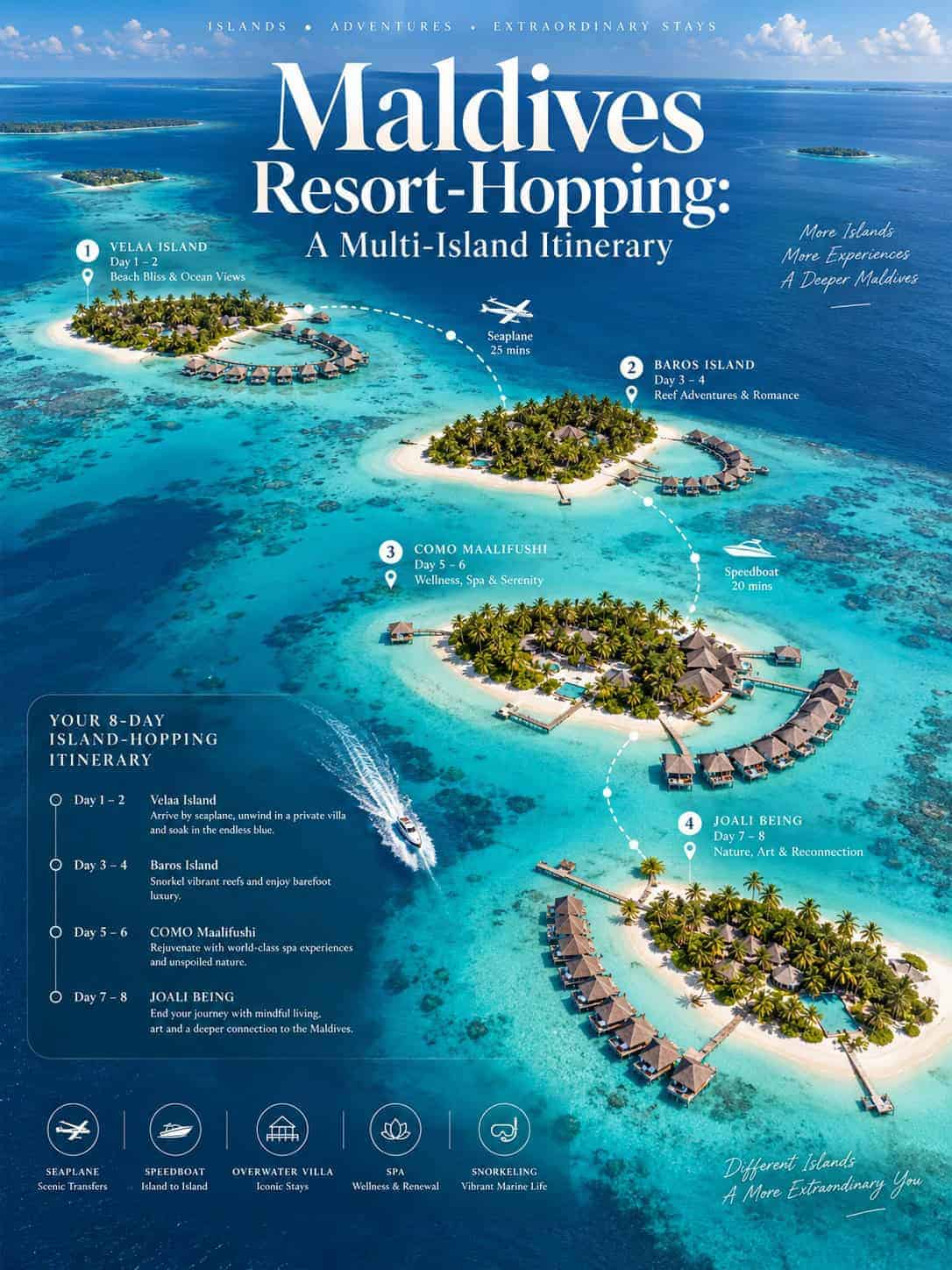
Maldives island hopping can combine two private-island resorts, different reefs and distinct experiences in one trip. However, the feasibility of a transfer between resorts matters more than the distance shown on a map. In practice, it’s a logistics decision before it’s a planning one, because every resort in the Maldives sits on its own private island with no public transit linking it to the next, and moving between two of them usually means a detour back through the exact hub you just left. This isn’t a day-by-day script; it’s the decision framework worth working through before booking two resorts instead of one.
Is Maldives Island Hopping Worth It?
For a one-week trip, usually not. A single transfer each way already eats a meaningful chunk of a short stay, and adding a second transfer mid-trip — routed back through Malé rather than directly between islands — can cost the better part of a travel day on top of real money. Resort-hopping earns its complexity on longer trips, generally two weeks or more, where the extra transfer is a small fraction of the total stay rather than a disruption to it. On anything shorter, one resort with a longer, more settled stay tends to deliver a better trip than two shorter, more rushed ones.
Maldives Island Hopping: Choose Nearby Atolls
The biggest lever for keeping a multi-resort trip manageable is picking resorts in the same atoll, or at least nearby atolls, rather than opposite ends of the country. Two resorts in the same atoll can often be connected by a private speedboat transfer arranged directly between them, which is faster and considerably cheaper than routing back through the airport. Pairing a resort in North Malé Atoll with one in, say, the deep south effectively means two full transfer days instead of a short inter-resort hop, which eats into the trip far more than most people budget for when they first picture “hopping” between islands.
How Maldives Resort Transfers Work Between Islands
Direct resort-to-resort transfers do exist, but they’re arranged privately between the two properties rather than booked as a standard package, and standard transfer networks are built to send guests back to the central Malé hub rather than to another resort directly. In practice, that means contacting both resorts ahead of time — the first to confirm a checkout-day transfer, the second to confirm pickup — and getting a direct quote for a private speedboat if the atolls are close enough to make one possible. Where a direct boat isn’t practical, the realistic fallback is a transfer back to the airport or a connecting domestic flight, followed by a separate transfer out to the second resort, which is slower and usually not noticeably cheaper than it sounds.
Maldives Two Resort Itinerary vs. Three Resorts
Three resorts in one trip is rarely worth it outside a long, deliberately slow-paced trip. Each additional resort adds another transfer, another round of settling in, and another block of nights that has to be long enough to feel worth the move — a two- or three-night stay barely outlasts the adjustment period before it’s time to pack again. Two resorts, each booked for a meaningful stretch (five nights or more apiece), generally gives a much better balance between variety and actually relaxing at either one.
A Multi Island Maldives Itinerary: Two Resort Stays
| Trip length | Suggested split | Transfer consideration |
|---|---|---|
| 7 nights | One resort, 7 nights | Avoid extra resort change unless essential |
| 10 nights | 5 + 5 nights | Ask both resorts for a confirmed connecting route |
| 14 nights | 7 + 7 nights | Allows time for two contrasting locations |
These are itinerary examples, not mandatory minimum stays.
A common, workable shape for a two-resort trip is to start somewhere closer to the airport and more socially active — a North or South Malé Atoll resort with a livelier restaurant scene and shorter transfer — and move to somewhere more remote and private for the second half, once the trip has settled into its rhythm. Doing it in the other order works just as well logistically; it comes down to whether easing into the trip or building toward its quietest stretch matters more.
Maldives Island Hopping Transfer Prices and Taxes
Actual transfer prices depend on the resort pair. Soneva Fushi and Soneva Jani publish a direct seaplane transfer of USD 300 per adult one way (USD 150 per child). They also offer a complimentary one-way speedboat, approximately 90 minutes, when both resorts are booked in the same trip under the stated conditions. Do not apply these prices to other resort pairs. For the airport leg, you can compare private airport transfers.
| Verified transfer example | Duration | Published price |
|---|---|---|
| Velana Airport to Niva Kurumba | 10 min, speedboat | Request resort quote |
| Velana Airport to Baros | 25 min, speedboat | Request resort quote |
| Velana Airport to Soneva Fushi | 30 min, seaplane | USD 1,300/adult return (2026) |
| Soneva Fushi to Soneva Jani | About 20 min, seaplane | USD 300/adult one way |
| Soneva Fushi to Soneva Jani | About 90 min, speedboat | Free one way under combined-stay conditions |
Maldives Island Hopping: Green Tax and Total Cost
Maldives resorts charge USD 12 Green Tax per guest per day of stay. Children under two are exempt. At a small guesthouse on an inhabited island with 50 or fewer registered rooms, the rate is USD 6 instead. Tourist goods and services are subject to 17% TGST; check whether quoted room and transfer prices already include applicable taxes and service charges.
| Example, two adults | Green Tax |
|---|---|
| 7 resort nights | USD 168 |
| 10 resort nights | USD 240 |
| 14 resort nights | USD 336 |
These are illustrative calculations using the published daily rate, not complete trip costs. Switching resorts does not create an extra Green Tax day by itself; the charge follows actual taxable periods of stay.
Seaplane transfers for a longer-distance resort move typically cost about USD 700-1,300 per adult round trip from the airport, depending on the resort and its distance from Malé, and a private inter-resort speedboat (where it’s available) is usually quoted separately by each resort rather than priced anywhere publicly. This cost is worth treating as a real line item in the trip budget from the start, not an afterthought — it’s an extra fare on top of the airport transfers at the start and end of the trip.
Maldives Resort Hopping: Real Resort Pairings
For a North Malé Atoll pairing, consider Niva Kurumba Maldives and Baros Maldives. Kurumba is approximately 10 minutes from Velana International Airport by speedboat, while Baros is approximately 25 minutes. Their proximity does not guarantee a direct resort-to-resort boat: request written confirmation from both properties before booking. Niva Kuramathi Maldives and V Villas Maldives at Mirihi offer contrasting experiences within the wider Ari Atoll region. Do not assume that a direct boat connects them. Obtain the complete transfer route, departure time and price from each resort first. For a longer, more ambitious trip, Baa Atoll’s Soneva Fushi (5-star, ultra-luxury — one of the properties on our most expensive resorts list) can anchor a remote final stretch after a more central first stay — just budget for a longer, pricier transfer to reach it. Pairing two overwater-villa-heavy resorts is easy to do this way too — see our guide to overwater villa resorts in the Maldives for picks across every budget. Before locking anything in, it’s worth checking accommodation and transfer options directly with both resorts rather than assuming a route exists, since not every pair of islands has a workable direct connection.
Booking Maldives Island Hopping Without Transfer Surprises
Get written confirmation of the inter-resort route, transfer operator, luggage allowance, total cost, pickup jetty and contingency for weather disruptions. Check whether either resort requires its own airport transfer even when arriving from another island.
Book the harder-to-get resort first, not necessarily the one that comes first in the itinerary. Smaller, more remote, or higher-demand properties fill up faster than larger central-atoll resorts, so locking in dates there before committing to the second resort avoids a situation where the dates on each end don’t line up cleanly. Once both resorts are confirmed, reach out to each about transfer logistics before finalizing flights — it’s far easier to adjust an inbound or outbound flight time than to renegotiate a transfer after both resort stays are already booked.
Maldives Island Hopping Luggage and Seaplane Limits
Trans Maldivian Airways allows 20 kg checked luggage plus 5 kg hand luggage per passenger. Excess baggage is USD 5 per kg before applicable taxes; a single bag must not exceed 32 kg. Infants do not receive a separate baggage allowance. Resort or charter policies may differ.
Seaplanes fly only in daylight. The operator advises arriving in the Maldives by 15:30 for a same-day resort connection. Late international arrivals may require an overnight stay or an available domestic-flight alternative.
Moving between two resorts mid-trip means repacking at least once in a hotel room rather than at home, so it’s worth packing with that in mind — a bag that’s reasonably easy to re-close rather than one that only worked zipped shut the first time. It’s also worth confirming each resort’s luggage policy for the inter-resort transfer specifically, since a seaplane or small speedboat can have tighter weight or bag-count limits than the main international flight did. Anything fragile or valuable is safer carried through the transfer personally rather than checked with transfer luggage, given the extra handling a resort-to-resort move involves compared to a single transfer straight from the airport.
Who Should Choose Maldives Island Hopping?
It fits travelers who specifically want variety within one trip — a different house reef, a different atmosphere, a different price point for part of the stay — more than it fits anyone chasing maximum relaxation from day one. Couples celebrating something longer than a standard honeymoon, groups splitting a trip between a social resort and a quieter one, and dedicated divers wanting access to two different dive regions all tend to get real value from the extra planning. A first-time visitor on a standard one- or two-week holiday, by contrast, is usually better served picking one well-chosen resort and spending the saved transfer time and budget on a longer, more settled stay there instead.
Frequently Asked Questions About Maldives Island Hopping
Is Maldives island hopping worth it on a one-week trip?
Usually not. A single extra transfer can eat a meaningful part of a short trip’s time and budget. Resort-hopping tends to work better on longer trips, generally two weeks or more, where the extra transfer is a smaller fraction of the overall stay.
Can you transfer directly between two Maldives resorts?
Sometimes, if they’re in the same or a nearby atoll and both resorts agree to arrange a private speedboat between them. Standard transfer networks are otherwise built to route back through Malé rather than resort to resort directly.
How many resorts should a Maldives trip include?
Two is usually the practical limit for most trips. Three or more adds enough transfer time and settling-in periods that it tends to undercut the relaxation a Maldives trip is supposed to deliver, unless the overall trip is unusually long.
Does it matter which atoll each resort is in?
Yes, significantly. Resorts in the same atoll or nearby atolls can often be connected by a direct private transfer; resorts at opposite ends of the country usually mean a full extra transfer day routed back through the airport.
How much does a Maldives two resort itinerary cost in transfers?
It depends on the resort pair. For example, Soneva Fushi to Soneva Jani costs USD 300 per adult by one-way seaplane, while a qualifying combined stay includes a complimentary one-way speedboat.
Can seaplanes transfer guests between resorts after dark?
No. Seaplanes operate only during daylight hours. Confirm connections before choosing a late international arrival.
Can I take 30 kg of luggage on a Maldives seaplane?
Standard TMA allowance is 25 kg total: 20 kg checked and 5 kg hand luggage. Extra baggage costs USD 5 per kg before applicable taxes.
Does Maldives resort hopping increase Green Tax?
No extra tax applies just for changing hotels. Standard resort Green Tax is USD 12 per guest per taxable day of stay, with an exemption for children under two.