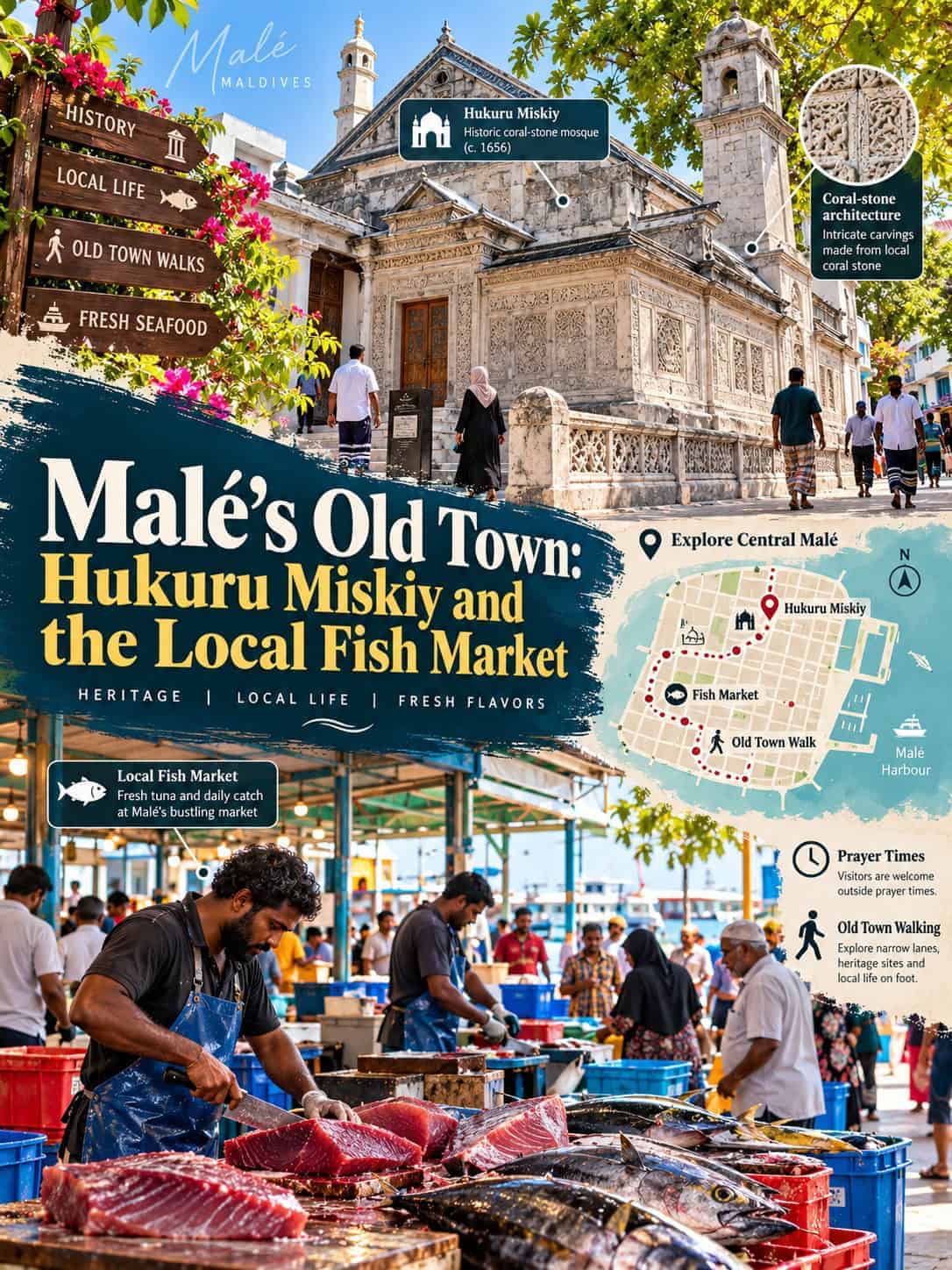
Most visitors pass through Malé only once, transiting between the airport and a resort speedboat, and never see the pocket of the capital that actually feels like a city rather than a logistics hub. Male old town — the dense tangle of streets around Hukuru Miskiy, the harbor and the fish market — is where that happens, and it’s compact enough to cover properly in a single afternoon if you have a layover or an extra night before or after a resort stay. Visitors of every nationality normally get a free tourist visa on arrival for 30 days (see our Maldives visa guide for specifics), so there’s no extra paperwork needed to justify a spontaneous detour here. If you land on a long layover, you can compare private airport transfers to Malé or browse local tours and excursions to plan the day.
This isn’t a polished tourist district. It’s a working slice of the capital — a 17th-century mosque a few steps from a fish market that’s still doing business, surrounded by narrow lanes, local shops, and tea houses that see far more Maldivians than foreign visitors. That’s exactly what makes it worth the detour.
Hukuru Miskiy: Historic Coral-Stone Mosque in Malé
Hukuru Miskiy, also known as the Old Friday Mosque, was completed in 1658 under Sultan Ibrahim Iskandhar I. Its carved coral-stone walls, wooden ceiling and lacquer calligraphy are important examples of Maldivian architecture. The mosque remains in use and belongs to the UNESCO Tentative List group of six coral-stone mosques; it is not yet a designated World Heritage Site.
Hukuru Miskiy is an active mosque, so non-Muslim visitors need permission from the Islamic Affairs staff at the mosque before entering; it is often given on the spot to conservatively dressed visitors outside prayer times, and the mosque is closed to visitors on Fridays. Avoid prayer times, cover shoulders and knees, and remove shoes if entry is permitted. Women should bring a scarf to cover their hair. The carved walls and minaret can be appreciated from outside, and the walled graveyard of carved coral tombstones can be walked without permission.
Hukuru Miskiy vs the Grand Friday Mosque
The Islamic Centre is near Hukuru Miskiy and is recognizable by its golden dome. Its Grand Friday Mosque is a modern place of worship, while Hukuru Miskiy preserves historic coral-stone construction. Opened in 1984, the Grand Friday Mosque admits visitors outside prayer times with shoulders and knees covered, so it is the easier of the two to see inside. The contrast between the two — a centuries-old coral stone mosque and a modern, large-capacity one just steps apart — says something about how Malé has grown, fast and vertically, around a historic core that’s easy to miss if you don’t specifically go looking for it.
The local fish market
The Malé fish-market district is traditionally a working waterfront where tuna and other local catches are traded. The tuna boats come in during the late afternoon, which is the time to see the catch landed, gutted and sold on the market floor; mornings are quieter. Expect a strong smell and wet floors, so wear closed shoes rather than sandals. It’s not a place built for tourists, and that’s precisely the appeal — a working market gives a far more honest sense of daily life in the Maldives than any resort ever will.
The local produce market is the part affected by redevelopment. The local market plot across the street from the fish market is set to be rebuilt as a six-story wet market complex, a project planned to take 30 months, and its produce and dried-fish stalls move to a temporary market before construction starts. Do not rely on older maps showing the markets side by side.
Hukuru Miskiy and the Old Town Walking Streets
Beyond the headline sights, old town Malé rewards aimless walking more than almost anywhere else in the country — narrow streets lined with small shops selling everything from hardware to fabric, local tea houses (known as “hotaa” locally) serving short eats and strong tea, and glimpses of daily Maldivian life that are impossible to find on a resort island. Majeedhee Magu, the capital’s main commercial street, runs along the edge of this district and is useful as an orientation point if you’re exploring without a fixed route.
Hukuru Miskiy and Malé Attractions: Quick Comparison
| Stop | Why visit | Access / cost |
|---|---|---|
| Hukuru Miskiy | 1658 coral-stone mosque, minaret and cemetery | Exterior and graveyard open; interior with permission; closed to visitors Friday |
| Islamic Centre | Modern Grand Friday Mosque and golden dome | Open to visitors outside prayer times |
| National Museum | Maldivian history and royal artifacts | Ticketed; 10 a.m.-4 p.m., closed Friday |
| Fish-market district | Working waterfront and seafood trade | Free; tuna landed in the late afternoon; local market stalls set to move for the rebuild |
| Sultan Park | Green space near the museum | Free |
The National Museum occupies a purpose-built building opened in 2010 beside Sultan Park, on the site of the former palace grounds. Its collections cover pre-Islamic artifacts, the sultanate and Maldivian craftsmanship. The museum opens 10 a.m. to 4 p.m. every day except Friday, with Saturday opening added in May 2026, and an hour is enough for the collection.
Hukuru Miskiy Area: Local Food and Tea Houses
The old town is one of the better places in Malé to eat like a local rather than a tourist. Short eats — small savory and sweet snacks traditionally served with tea at a hotaa — are the signature local food experience here, usually cheap, fast, and very different from resort dining. Dawn Café, by the fish market, is a long-running budget tea shop full of fishermen, and the café upstairs in the fish market building serves rice and tuna curry and is busiest in the afternoon. Elsewhere, look for places busy with local office workers around lunchtime, which is a reliable signal for good, authentic food rather than anywhere obviously set up for visitors. A few blocks from the fish market, small seafood restaurants serve the day’s catch simply grilled or curried — classic Maldivian food rather than resort fusion menus, often at a fraction of resort restaurant prices.
Coffee culture has also grown considerably in Malé in recent years, and a handful of specialty cafés have opened around the old town and nearby streets, offering a comfortable break between sightseeing stops if the heat and crowds become a lot.
Hukuru Miskiy and the History of Old Malé
Malé’s extreme density — among the highest of any capital city in the world — comes from a simple constraint: the island itself is tiny, and for most of the country’s history there was nowhere else for the capital to expand. That pressure produced a city of narrow streets and tall, closely packed buildings wrapped around a historic core that predates almost all of the development around it. Walking from the old town’s low coral-stone mosque buildings toward the newer high-rise blocks nearer the harbor makes that contrast, and the city’s growth story, physically visible in a way that’s hard to get from reading about it. Hulhumalé, the reclaimed island connected to Malé and the airport, exists specifically because Malé itself ran out of room to grow.
Hukuru Miskiy Walking Route and Time Needed
A self-guided route can start at Hukuru Miskiy, continue to the Islamic Centre and National Museum, then head toward the harbor to reach the fish market in the late afternoon, when the boats come in. Allow roughly two to three hours for the outdoor walk and additional time if visiting the museum. Combined with Malé’s harbor area and a meal at a local café, it fills a satisfying afternoon for anyone with a layover between flights and a resort transfer, or a night in the capital at either end of a trip.
Where to stay for an old town visit
Our Malé guide covers city hotel options across the capital in detail, and for an old town-focused visit specifically, staying anywhere within the capital’s compact core keeps everything in this guide within easy walking distance — Malé is small enough that no hotel in the city center puts you more than a 15-20 minute walk from Hukuru Miskiy and the fish market. If you’re arriving late or departing early and just need a convenient, practical base near the airport instead, Hulhumalé is the more common choice, with a short ferry or bridge connection back into Malé proper for an old town visit on a free afternoon: the public ferry costs MVR 10 and takes about 20 minutes, and a government taxi costs MVR 85 from Phase 1 or MVR 100 from Phase 2. Straight from the airport, the public ferry to Malé costs MVR 15 and takes about 10 minutes, and a government taxi costs MVR 70.
Hukuru Miskiy Area: Shopping and Souvenirs
The streets around the old town and Majeedhee Magu are the most practical place in the country to buy souvenirs beyond a resort gift shop’s markup — local handicrafts, woven items, and Maldivian spices sold at prices that reflect a real local market rather than a captive resort audience. It’s also where locals themselves shop for everyday items, from hardware to clothing to electronics, which makes browsing here a genuinely different experience than the curated boutiques found at most resorts.
Hukuru Miskiy Visitor Rules and Practical Tips
Malé’s old town is a conservative area even by Maldivian standards, given its concentration of mosques, so modest dress (shoulders and knees covered) is expected throughout, not just when entering religious sites directly. The streets are narrow and often busy with scooters, so pedestrians need to stay alert in a way that’s less necessary on quieter local islands elsewhere in the country. Friday is the weekly day off: Hukuru Miskiy and the National Museum are closed to visitors, and many shops and cafés open only after the midday prayer, so a Saturday-to-Thursday visit is far more straightforward. On any day, shops and cafés close briefly at each of the five prayer times.
Frequently asked questions
Can non-Muslims visit Hukuru Miskiy’s interior?
Yes, with permission from the Islamic Affairs staff at the mosque, which is often given on the spot to conservatively dressed visitors outside prayer times. The mosque is closed to visitors on Fridays. Even when interior access isn’t available, the exterior coral stonework and surrounding cemetery are worth seeing on their own.
What’s the best time of day to visit the fish market?
Late afternoon is the most active time, when the tuna boats are unloading and vendors are processing the day’s catch; mornings are quieter and better suited to the produce and dried-fish stalls.
How much time should I budget for Malé’s old town?
Two to three hours covers the core sights — Hukuru Miskiy, the Islamic Centre, and the fish market — at an unhurried pace, making it a comfortable half-day activity rather than something requiring a dedicated overnight stay.
Is Malé’s old town safe to walk around?
Yes, it’s generally safe for pedestrians, though the narrow streets carry a lot of scooter traffic, so it pays to stay alert in a way that’s less necessary on the quieter local islands elsewhere in the Maldives.