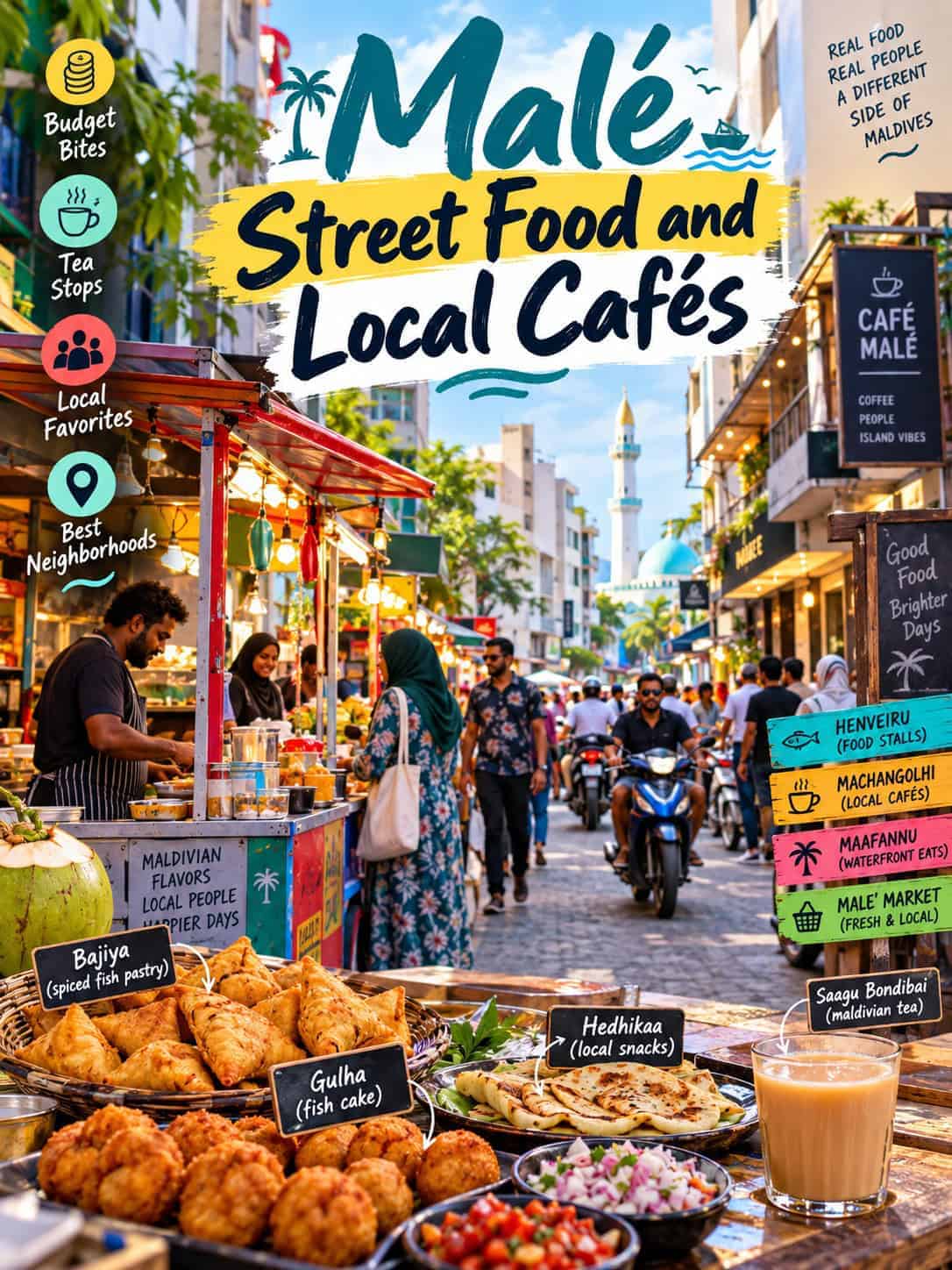
Most Maldives itineraries treat Malé as a layover, a place to pass through between the airport and a seaplane dock. Male street food, Maldivian street food and the capital’s local cafés rarely make it onto a resort-focused trip, and knowing where to eat in Male is the first step. That’s a mistake for anyone who actually wants to taste Maldivian food, because almost none of it is served on resort islands. Here’s a walk through the capital’s actual eating scene, neighborhood by neighborhood.
Male Street Food at a Glance
| What to try | What it is | Where to find it |
|---|---|---|
| Bajiyaa | Samosa-like fried pastry | Hotaa cafés |
| Gulha | Deep-fried tuna and coconut ball | Hotaa cafés |
| Kulhi boakibaa | Spiced fish cake or pie | Hotaa cafés |
| Mas huni and garudhiya | Classic Maldivian tuna dishes | Local cafés |
| Fresh juice | Mango, watermelon and papaya blends | Juice stalls |
Start at the Fish Market for Male Street Food
Malé’s fish market sits right on the waterfront and is the most honest starting point for understanding what the city eats. Fishermen bring in the day’s catch, overwhelmingly tuna, and sell it directly to buyers, while nearby stalls and small eateries cook and serve portions of that same catch within hours of it coming off the boat. Walking through in the late afternoon, when the tuna boats are unloading, gives the clearest sense of just how central tuna is to everything else on this list. It is also where Maldivian street food starts, since the tuna sold here ends up in most local snacks.
Hotaa Cafés: Male Street Food and Local Cafés
A short walk from the market, Malé’s hotaa, small local cafés, are where the actual daily eating happens. These are not restaurants in the resort sense; they’re unpretentious rooms with trays of hedhikaa, Maldivian short eats, piled up for customers to choose from through the afternoon and evening. Expect bajiyaa (samosa-like fried pastries), gulha (deep-fried tuna-and-coconut balls), and kulhi boakibaa (a spiced fish cake or pie), at roughly MVR 3-15 a piece, so a full tea-time spread with a glass of sweet sai tea costs a fraction of a resort snack. Trays sit on the counter, so you simply point at what you want. This is also where mas huni and garudhiya, two of the dishes covered in our Maldivian food guide, show up on an actual daily menu rather than a curated “local night” buffet. The places below are where to eat in Male for hedhikaa and everyday Maldivian street food at local prices.
Named Hotaa and Cafés to Try
| Place | Where | What to order | Good to know |
|---|---|---|---|
| Dawn Café | By the fish market and local market on the northern waterfront | Gulha, bajiyaa and other short eats with sai tea | A long-running budget tea shop busy with fishermen and locals |
| Maarukeytu Hota | Upstairs in the fish market building | Rice with tuna curry or grilled fish, plus short eats | Busiest in the afternoon, no English menu; a local meal like this runs roughly MVR 60-120 |
| Moon Café | Banafsaa Magu, opposite Galolhu Stadium; a second branch, Baazaaru Moon Café, is by the market | Tea-time short eats or a Dhivehi keun rice-and-curry platter | A sit-down hotaa away from the waterfront crowds |
| Seagull Café | Fareedhee Magu, in the central shopping streets | Homemade ice cream or a cold drink | Best known for its ice cream; a sit-down break from the heat |
The Local Market for Produce and Snacks
Malé’s local market, near the fish market, sells fresh produce and prepared local food, a useful stop for anyone wanting to see what a Maldivian household kitchen actually buys day to day, since so little of it is grown locally and so much arrives by boat from outer islands or by import. Stalls sell vegetables, fruit, yams, breadfruit chips and smoked and dried tuna from the atolls, which makes it a good place to pick up a bag of chips for the walk. The market plot across the street from the fish market is set to be rebuilt as a six-story wet market complex, and its stalls move to a temporary market before construction starts, so some vendors may not be where older maps show them. It’s a market built for residents rather than visitors, which makes it one of the more unfiltered places in the city to see ordinary Maldivian food culture up close.
Juice Stalls for a Break
Scattered through the city center, fresh juice stalls blend mango, watermelon, and papaya into cold drinks on the spot, a straightforward and reliably good way to cool down while walking Malé’s dense, shadeless streets. These stalls are casual and informal, usually just a cart or small counter rather than a sit-down café, and they’re one of the easiest “local” experiences to fold into a short layover without needing much time. Young coconut, called kurumba, is the other cold drink to look for on a Maldivian street food walk, drunk straight from the shell.
Where to Eat in Male: The International and Upscale Strip
Malé does have a more polished dining scene for travelers who want it. Jen Malé by Shangri-La offers fine dining with international and contemporary cuisine, some locations with city views, inside an upscale hotel setting. Sala Thai and The Sea House both sit in the mid-range tier, serving international menus at what locals and reviewers describe as reasonable prices, and both occupy fairly central locations that are easy to combine with a walk through the older parts of the city. Sala Thai is on Buruneege Hithaffinivaa Magu beside the Sala Boutique Hotel, near the People’s Majlis, and The Sea House sits upstairs in the Hulhumalé ferry terminal on the waterfront road, Boduthakurufaanu Magu, with seafood and Asian mains at about $8-15. None of these are where to find authentic Maldivian food specifically, but they round out Malé’s food scene for anyone splitting a day between local cafés and a more familiar sit-down meal.
Crossing the Bridge to Hulhumalé
Hulhumalé, the reclaimed island connected to Malé by the Sinamalé Bridge and home to the airport side of the city, has a newer, more spread-out feel than central Malé, with wider streets and more modern apartment blocks. It’s increasingly common for visitors on a longer layover to base themselves there instead, often in rented apartments with kitchens, which has made self-catering a realistic option in a way it generally isn’t in dense, hotel-scarce central Malé. For simple, cheap places to sleep near the capital, see our budget guesthouses guide. The café and dining scene in Hulhumalé continues to grow alongside the area’s residential expansion, though it leans more toward convenience dining for residents than toward a defined food destination the way central Malé’s hotaa culture does.
Male Street Food: Planning the Walk Around a Layover
For travelers with only a few hours between flights and a resort transfer (our guide to the Malé airport resort transfer shows how the timings work, and private airport transfers can be booked ahead), the fish market and a nearby hotaa café make the most efficient combination: both are close to the waterfront, both take well under an hour, and both give a genuine taste of what Malé actually eats rather than a tourist-facing version of it. From the airport, the public ferry to Malé costs MVR 15 and takes about 10 minutes, or a government taxi costs MVR 70 if you have bags. Travelers with a full day can extend that walk through the local market, a juice stall stop, and one of the mid-range international restaurants for contrast, before heading back toward the airport or onward to a resort transfer. This route answers the common question of where to eat in Male with limited time.
What This Says About Maldivian Food Generally
Malé’s eating scene is really a concentrated version of what’s true everywhere in the Maldives outside the resorts: fish, coconut, and rice dominate, prices are a fraction of resort dining, and almost none of it is marketed toward visitors. The city doesn’t have a polished “street food scene” built for tourism the way some Southeast Asian capitals do; it has ordinary, functional eating places that happen to be open to anyone willing to walk in, which is exactly what makes them worth seeking out. In that sense Maldivian street food is simply the city’s everyday food.
Getting Around on Foot
Malé is one of the most densely packed capital cities in the world, built on a small reclaimed island with narrow streets laid out in a tight grid, which makes it genuinely walkable in a way few capital cities are. Most of the stops on this walk, the fish market, the local market, nearby hotaa cafés, and the mid-range international restaurants, sit within a compact central zone that can comfortably be covered on foot in a few hours without needing a taxi. Hulhumalé, by contrast, is more spread out and generally requires a taxi or the public bus connection over the Sinamalé Bridge rather than walking; a government taxi from Malé costs MVR 85 to Phase 1 and MVR 100 to Phase 2.
Timing and Practical Notes
Hotaa cafés tend to be busiest in the late afternoon and early evening, which lines up with the traditional hedhikaa tea-time custom, making that window the best time to see the fullest spread of short eats rather than a picked-over tray. The fish market is busiest in the late afternoon, when the tuna boats come in; mornings are better for produce and dried fish at the local market. Cash remains useful at smaller hotaa cafés and market stalls even as card payment has become more common at the mid-range and upscale restaurants, so carrying some Maldivian rufiyaa is worth it for a food-focused walk through the city rather than relying entirely on cards. A Maldives eSIM set up before you land also makes maps and translation easy on the walk, as covered in our Maldives SIM and eSIM guide.
Shops and cafés close briefly, for about 15 minutes, at each of the five daily prayers, so a hotaa may pull its shutter just as you arrive; a short wait solves it. Friday is the weekly day off: many cafés open only after the midday Friday prayer, and some not until late afternoon, so Saturday to Thursday is easier for a food walk. During Ramadan most cafés stay closed through the day and open after sunset.
Why So Few Visitors Ever See This Side of the Maldives
The standard Maldives itinerary is built specifically to route travelers around Malé rather than through it: speedboat and seaplane transfers from the airport are designed to get guests to their resort island as quickly as possible, often within an hour of landing, with no reason built into the itinerary to stop in the capital at all. That logistics-first design is good for resort efficiency but means most visitors never see the fish market, never eat at a hotaa café, and never taste mas huni or garudhiya outside of a resort’s occasional themed buffet. A deliberate stopover, even a few hours on arrival or departure day, is really the only way most travelers will ever encounter this side of the country at all. Even a short stop to try Maldivian street food changes how the trip feels.
Male Street Food: Frequently Asked Questions
What is the best Male street food to try first?
Start with hedhikaa, the local short eats such as bajiyaa, gulha and keemia, at a hotaa café in the late afternoon, for example Dawn Café by the fish market.
Is Male street food cheap?
Yes. Short eats cost roughly MVR 3-15 each, and a rice-and-curry meal at a local eatery runs about MVR 60-120.
Where do locals eat in Male?
In hotaa cafés such as Dawn Café, Maarukeytu Hota above the fish market and Moon Café on Banafsaa Magu, and in small eateries near the fish market, which serve the day’s tuna catch within hours of it landing.
How long do I need to try Male street food?
A few hours is enough: the fish market and one hotaa café take well under an hour, and a longer walk can add the local market and a juice stall. Go in the late afternoon, Saturday to Thursday, to catch both the tuna boats and the fullest tea-time trays.
Should I carry cash?
Yes. Cash is still useful at hotaa cafés and market stalls, even though cards are more common at mid-range and upscale restaurants.