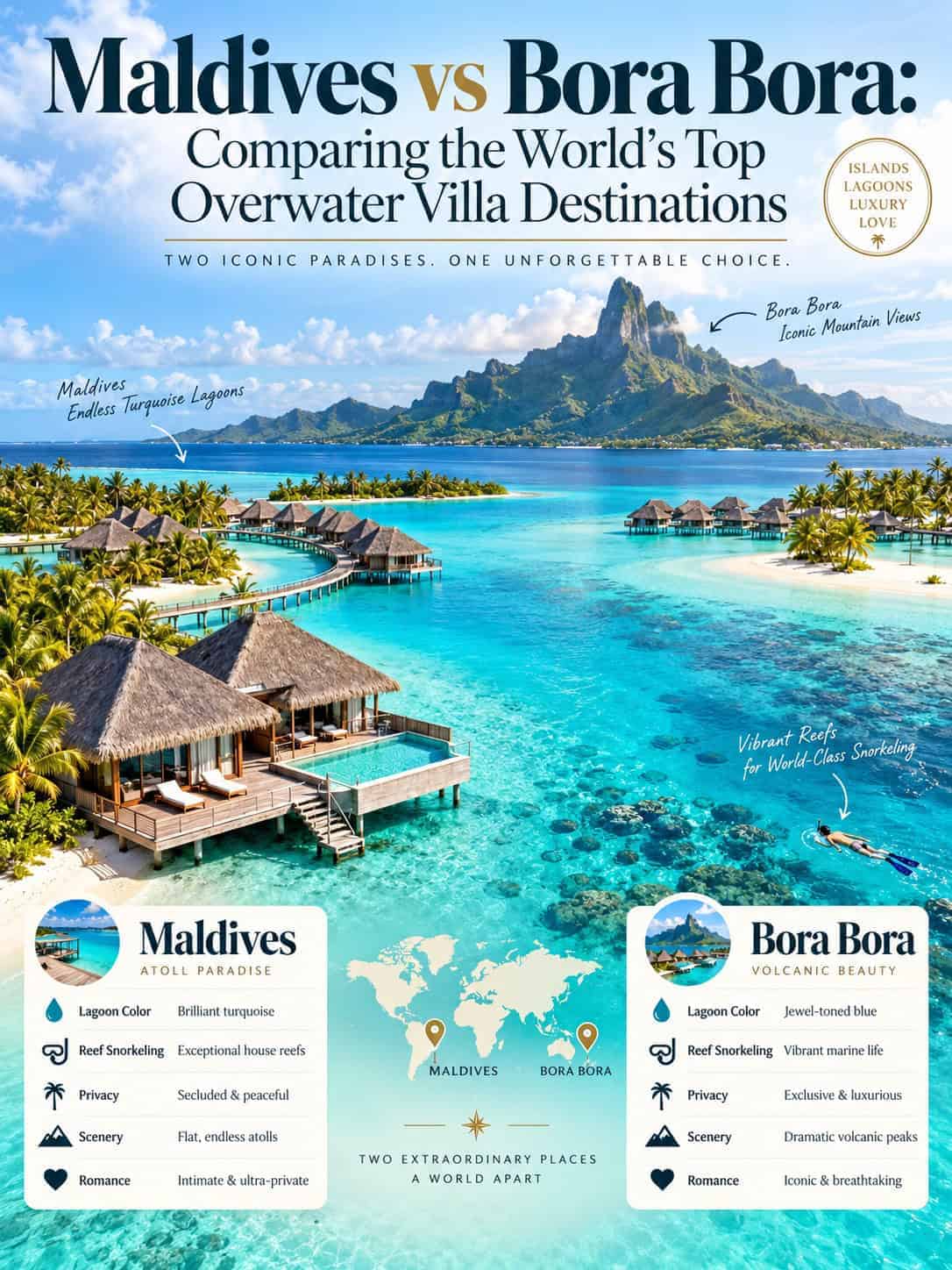
Every overwater villa brochure photo you’ve ever scrolled past traces back to the same place: a reef off a small island in French Polynesia, not the Maldives. The two destinations get lumped together constantly, usually as a binary honeymoon choice, but they arrived at the overwater villa from completely different directions, and that history still shapes what you get for your money today. One invented the idea almost by accident. The other turned it into a global industry. This Maldives vs Bora Bora comparison covers the cost, the honeymoon question of Bora Bora or Maldives, and an overwater bungalow comparison of the villas themselves, starting with where the whole concept began.
Maldives vs Bora Bora at a Glance
| Maldives | Bora Bora | |
|---|---|---|
| Overwater villas | Around two-thirds of all overwater bungalows worldwide | Where the concept began, in 1967 on Raiatea |
| Resort model | One island, one resort | Resorts share islands with villages and hotels |
| Price range | Wide, from mid-range to ultra-luxury | Clustered in the ultra-luxury tier |
| Scenery | Flat coral islands | Volcanic peak, Mount Otemanu |
| Marine life | Mantas, whale sharks, intact house reefs | Calm lagoon, rays and reef sharks |
| Easier from | Europe, the Middle East, Asia | The Americas |
Where the Overwater Villa Actually Began
The overwater bungalow was not born in the Maldives. It was born on Raiatea, in French Polynesia, in 1967, and the people responsible were three American expats known locally as the “Bali Hai Boys,” among them Hugh Kelley, who had been running the Hotel Bali Hai on Moorea since 1962.
By 1967 the Bali Hai Boys were running a second property on Raiatea that had a good reef but no real beach. Hugh Kelley’s solution was to build guest bungalows out over the reef itself, directly inspired by the traditional fishing huts Tahitians had long built over shallow water. That single practical fix, solving a beachless site rather than chasing a design trend, is the entire origin of the overwater villa. The overwater bungalow turned 50 in 2017, and in April of that year the Conrad Bora Bora Nui reopened with 86 overwater bungalows, including two-story Presidential Villas.
How the Maldives Turned the Idea Into an Industry
French Polynesia still has the deepest roots, with 884 overwater bungalows in 22 hotels on seven islands in 2017, part of a global total of roughly 7,000. But the Maldives took the concept and scaled it further than anywhere else. Today the Maldives holds around two-thirds of all the overwater bungalows on Earth, built across roughly 175 to 180 resorts (178 were operating at the end of 2025), most of which occupy an island of their own.
That one-island-one-resort model is the structural difference that matters most. In French Polynesia, overwater bungalows sit alongside beach bungalows on islands that often have villages, roads, and other hotels nearby. In the Maldives, an entire island is usually leased to a single resort, so every villa, overwater or on-land, belongs to the same operator and the same closed environment. It is a more intensive, purpose-built version of the same original idea.
Getting There: Flight Time Is the Real Dividing Line
This is where the two destinations diverge hardest for most travelers. Bora Bora is reached via a long-haul flight to Tahiti (Papeete) from the US West Coast or increasingly via routes through Auckland, Paris, or Tokyo, followed by a roughly 45 to 55 minute domestic flight on Air Tahiti to Bora Bora’s airport, which sits on its own motu and requires a short boat transfer to most resorts. Some Air Tahiti flights stop at Moorea, Huahine or Raiatea on the way, which makes the hop longer than the nonstop service.
The Maldives is reached via a long-haul flight into Velana International Airport near the capital, Malé, typically from Europe, the Middle East, or Asian hubs, followed by either a speedboat transfer (about 30 to 60 minutes for nearby atolls) or a seaplane flight (roughly 10 to 35 minutes in the air for the Malé and Ari atolls, plus waiting time), with a domestic flight plus boat for the far atolls. For travelers based in Europe or Asia, the Maldives is almost always the shorter overall journey. For travelers based in the Americas, Bora Bora is usually closer. You can compare flights to Malé early, and our guide to getting to the Maldives covers routes, while airport transfers in Malé can be booked in advance. Neither destination is a quick weekend trip from most of the world, which is exactly why both built their reputations on honeymoons and milestone trips rather than short breaks.
Flight Times From Europe, the US, Asia and Australia
| Flying from | To Malé (Maldives) | To Papeete (then on to Bora Bora) |
|---|---|---|
| Europe | About 10 hours nonstop from London; from most other cities, one stop via Dubai, Doha or Abu Dhabi, each 4 to 5 hours from Malé | About 20 to 22 hours from Paris, including the stop in Los Angeles |
| US West Coast | No nonstop; at least one stop via a Gulf, European or Asian hub | About 7.5 hours nonstop from Los Angeles |
| East Asia | About 4.5 hours nonstop from Singapore | About 11 hours nonstop from Tokyo Narita |
| Australia and New Zealand | No nonstop for most travelers; one stop via Singapore or a Gulf hub | Under 5 hours from Auckland; about 7 hours nonstop from Sydney from mid-December 2026, twice a week |
Entry Rules: Visa on Arrival vs Visa-Free
Neither destination asks most Western travelers for a visa in advance, but the rules work differently. The Maldives gives tourists a free visa on arrival, generally for up to 30 days, and every arriving passenger fills in the free IMUGA Traveller Declaration online within 96 hours before landing. French Polynesia is a French overseas territory with its own entry rules: UK, US and Australian passport holders can stay without a visa for up to 90 days, and the passport must remain valid for at least three months after the date you leave. You clear immigration once, at Papeete’s Faa’a airport, before the domestic flight to Bora Bora.
Maldives vs Bora Bora Cost: Where the Money Actually Goes
Both destinations sit at the expensive end of the overwater villa market, but the shape of the cost is different. Bora Bora’s overwater bungalows cluster heavily in the ultra-luxury tier: resorts like the Conrad Bora Bora Nui (5-star, ultra-luxury) and the St. Regis Bora Bora Resort (5-star, ultra-luxury) anchor the market, with relatively few true budget alternatives on the water itself. Land-based rooms exist at lower price points, but the overwater experience specifically is priced as a premium add-on almost everywhere. In a Maldives vs Bora Bora cost comparison, the Maldives is the one with more entry points.
The Maldives spreads much wider. It still has genuine ultra-luxury overwater properties such as Soneva Fushi (5-star, ultra-luxury) and One&Only Reethi Rah (5-star, ultra-luxury), but it also has a real mid-range tier, with resorts like Kuredu Island Resort & Spa (4-star, mid-range) offering a different price point from Bora Bora. If an overwater villa is non-negotiable but the budget is not unlimited, the Maldives currently offers more entry points — see our full guide to overwater villa resorts in the Maldives for the complete range.
What an Overwater Night Costs in Each
| Per night for the room | Maldives | Bora Bora |
|---|---|---|
| Value end | Resorts with water bungalows, such as Ellaidhoo and Jawakara, start around $280 to $320; the overwater category usually costs more than the entry room | Overwater bungalows from about €800 at Maitai Polynesia in July, the high season; its garden bungalows start at about €300 |
| Luxury | Ultra-luxury seaplane resorts such as Soneva Jani and Waldorf Astoria Maldives Ithaafushi sit at the top of the market | In July, overwater from about €2,300 at the Conrad Bora Bora Nui, €2,500 at the Four Seasons and €3,700 at the St. Regis |
| Getting to the resort | Seaplane $700 return per adult at Conrad Maldives, $1,300 at Soneva Jani; speedboat resorts near Malé from $185 per adult (Villa Nautica) | Air Tahiti from Papeete, then a resort boat to the island |
| Added to the bill | 10% service charge, 17% TGST and a $12 green tax per person per night | Government taxes and service charge, plus a city tax of 200 XPF per person per night |
Over a seven-night stay for two, the gap sits mostly in the entry price and the extras. A week in Maitai’s overwater bungalows in July starts around €5,600 and at the Conrad Bora Bora Nui from about €16,100. On the Maldives side, a $700-per-adult seaplane adds $1,400 for a couple, and the service charge and TGST alone add at least 27% to the room rate.
The Villa Experience Itself
French Polynesian overwater bungalows tend to follow a fairly consistent architectural language: thatched or shingled peaked roofs, dark timber decking, and glass panels in the floor for fish-watching, built over genuinely clear, shallow lagoon water that is often calm enough to swim in directly from the steps. Bora Bora’s lagoon is also famously huge and ringed by a barrier reef, which gives many overwater bungalows a direct view of the island’s volcanic peak, Mount Otemanu, a backdrop the Maldives simply cannot replicate since its islands are flat coral formations with no mountains at all. This overwater bungalow comparison is where Bora Bora’s scenery shows.
Maldivian overwater villas vary more by resort, from minimalist contemporary design to more elaborate multi-level villas with private pools, but they share the advantage of generally larger, more private lagoon frontage per villa, since Maldivian resort islands are smaller and more spread out than Bora Bora’s. Private pools on the deck are far more common in the Maldives than in Bora Bora, where many overwater bungalows still rely on direct lagoon access rather than a plunge pool. In any overwater bungalow comparison, the Maldives wins on privacy.
Marine Life: What’s Actually Under Your Deck
Bora Bora’s lagoon is calm and shallow, making it excellent for casual snorkeling with reef fish, rays, and reef sharks directly visible from overwater steps, though the lagoon’s heavy tourist traffic (jet skis, lagoon tours) means it is not a serious diving destination from the villa itself. The Maldives generally offers more dramatic marine encounters: resorts near channels and thilas can have manta ray cleaning stations, whale shark season, and visible reef shark activity close to the house reef, and Maldivian house reefs tend to be more intact and closer to the villa than in much of Bora Bora’s more developed lagoon.
Maldives vs Bora Bora Honeymoon: Which One Fits You
Choose Bora Bora if a dramatic mountain backdrop matters to the photos, if you are traveling from the Americas, or if you want the destination that invented the concept and still does the classic version of it best. If you are leaning toward the Maldives, our list of honeymoon resorts is the next step. Choose the Maldives if marine life and reef access matter more than scenery, if you are traveling from Europe, the Middle East, or Asia, or if you want a wider range of price points without giving up the overwater villa itself. Both destinations are built around the same original idea from a reef in Raiatea in 1967; what differs now is scale, geography, and exactly how much of your trip happens underwater versus on the horizon. For a Maldives vs Bora Bora honeymoon, that is the short answer.
Weather and Timing: Avoiding Each Destination’s Wet Season
Both destinations sit close to the equator and run on a dry-season/wet-season cycle rather than four seasons. Bora Bora’s dry season runs roughly May through October, with the driest, most reliable weather from June to September; November through April brings more rain and a higher (though still moderate) cyclone risk. The Maldives splits into two monsoons: the dry, sunnier northeast monsoon runs roughly December through April, while the wetter southwest monsoon runs May through November and brings more rain, wind, and swell, though it also brings the plankton that draws manta rays to Hanifaru Bay in Baa Atoll. Our best time to visit the Maldives guide has the month-by-month detail. Booking either destination in its respective shoulder season, April-May for Bora Bora or November for the Maldives, usually gets lower rates with only a modest weather trade-off. For how the Maldives stacks up against other Indian Ocean rivals, see our Maldives vs Zanzibar and Maldives vs Mauritius comparisons.
Maldives vs Bora Bora: FAQ
Is the Maldives or Bora Bora better for a honeymoon?
Choose Bora Bora for the mountain backdrop and if you are traveling from the Americas, and the Maldives for marine life, more price points and a shorter trip from Europe or Asia.
Which is cheaper, the Maldives or Bora Bora?
The Maldives has a wider price range, including mid-range options, while Bora Bora overwater bungalows cluster in the ultra-luxury tier.
Where did overwater villas originate?
On Raiatea in French Polynesia in 1967, not in the Maldives.
When is the best time for each destination?
Bora Bora is driest from roughly May to October, and the Maldives from roughly December to April.
Maldives vs Bora Bora in Numbers
These figures come from tourism ministries and press reports; prices change by season, so treat them as indicative.
| Fact | Maldives vs Bora Bora |
|---|---|
| Visitors in 2025 | Maldives 2,246,516 arrivals; French Polynesia 281,227 tourists, a record |
| Resorts | Maldives: 178 operating resorts with 44,697 beds at the end of 2025 |
| Overwater bungalows | French Polynesia: 884 in 22 hotels on seven islands (2017 count) |
| Conrad Bora Bora Nui | 114 rooms, 86 of them overwater, reopened in April 2017 |
| Papeete to Bora Bora flight | About 45 to 58 minutes with Air Tahiti |
| Visitor tax | Maldives green tax $12 per person per night at resorts; Bora Bora about 200 XPF per person per night in classified hotels (approximate) |
| Overwater villa prices | At luxury Maldives resorts roughly $1,000 to $5,000+ per night depending on resort and season (indicative) |