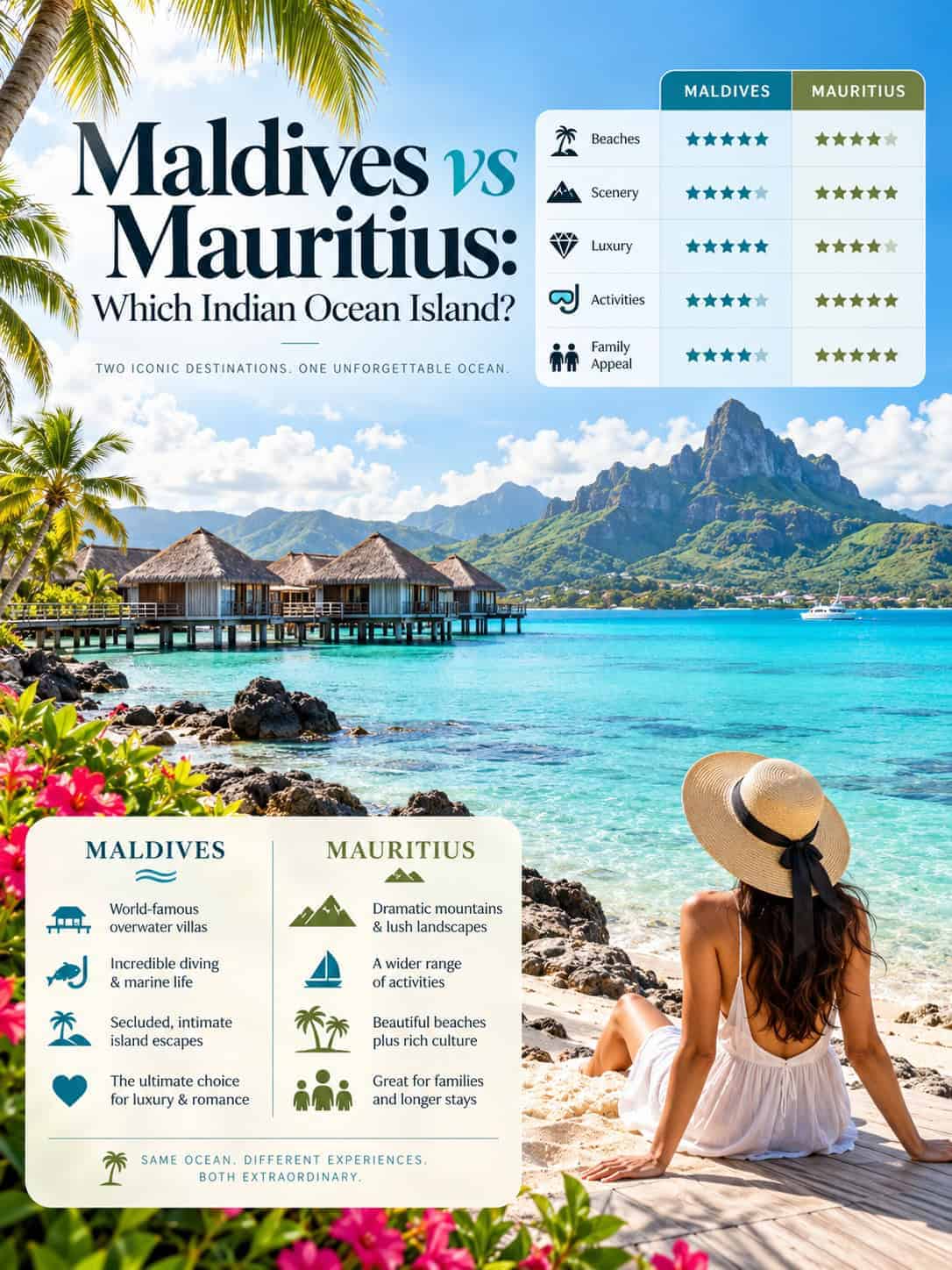
Every Maldives vs Mauritius comparison tends to repeat the same handful of assumptions, and not all of them hold up once you actually look at what each destination offers. Both sell an Indian Ocean escape, so the Maldives or Mauritius honeymoon question comes up constantly, and an Indian Ocean honeymoon comparison usually also turns into a Mauritius vs Maldives cost debate — but a few of the most common claims about how they differ are either outdated, oversimplified, or flat wrong. Working through the real comparison myth by myth is more useful than another side-by-side list, so we start with a quick summary and then test each claim. (For a very different kind of rival — far cheaper, more culturally rich — see our Maldives vs Zanzibar guide instead.)
Maldives vs Mauritius at a Glance
| Question | Maldives | Mauritius |
|---|---|---|
| Best known for | Overwater villas and seclusion | Beaches plus a varied interior |
| Things to do beyond the resort | Limited unless you add a local island | Hiking, gardens, Port Louis, markets |
| Diving and snorkeling | Stronger reputation, shallow reef close to shore | Good, but not the main draw |
| Getting there | Flight plus seaplane, speedboat or domestic flight | Flight plus a road transfer |
| Overwater villas | A signature feature | Rare; only a handful of resorts |
Maldives vs Mauritius Cost: Is the Maldives Always More Expensive?
Reality: Resort-for-resort, the Maldives does tend to run slightly pricier than an equivalent Mauritius property, and the full trip cost usually widens that gap rather than closing it. The Maldives typically adds a domestic flight or seaplane transfer on top of the international leg, which Mauritius generally doesn’t require, since its resorts are a road transfer from the airport. That extra leg runs about $185-260 return per adult by resort speedboat near Malé and $700-1,300 return per adult by seaplane, depending on the resort, so it adds to the Maldives side of the bill rather than evening it out. Both destinations also span a genuinely wide range from budget-friendly to ultra-luxury, so “the Maldives is expensive” really means “the top end of the Maldives is expensive,” which is also true of Mauritius at its own top end. In short, the Mauritius vs Maldives cost gap is smallest on a Maldives local-island budget and widest at seaplane resorts.
Per-night taxes point the same way once they are put in the same terms. The Maldives charges a Green Tax of $12 per person per night at resorts and $6 at guesthouses with 50 rooms or fewer (children under two pay none), and resort rates are usually quoted before a 10% service charge and 17% tourism GST. Mauritius has charged a Tourist Fee of €3 per person per night since October 1, 2025, for guests aged 12 and over, collected by the hotel, and accommodation there carries 15% VAT. For a couple spending seven nights at a resort, that is $168 in Green Tax in the Maldives against €42 in Tourist Fee in Mauritius, before the Maldives transfer is added.
Myth: Mauritius Doesn’t Have Real Beaches or Water Activities
Reality: Mauritius’s lagoons and beaches, particularly around Grand Baie, Pereybere, and Trou aux Biches, are genuinely excellent, protected by one of the most extensive coral reef systems in the Indian Ocean. What it doesn’t have is the Maldives’ overwater villa culture or quite the same shallow, resort-adjacent snorkeling the Maldives is known for — the water experience is strong but structured differently, more beach-and-boat-trip than step-off-your-villa-deck.
Myth: The Maldives Is Just Resorts, With Nothing Else to Do
Reality: This one is mostly true for a standard resort-only booking, but it’s not the whole picture. A Maldives trip built entirely around one resort island genuinely does offer limited excursions beyond diving, snorkeling, and the resort’s own activity program — that’s a structural feature of how most resort islands work, not a flaw specific to any one property. What the myth misses is that this is a choice, not an inherent limitation of the country: pairing a resort stay with a local island, as covered in our resort island vs local island guide, opens up a genuinely different, more varied side of the Maldives that a resort-only itinerary never touches.
Myth: You Can’t Do Much in Mauritius Beyond the Resort
Reality: This is the inverse problem, and it’s further from the truth. Mauritius has a notably green, walkable interior with real hiking, the Sir Seewoosagur Ramgoolam Botanical Gardens, and a capital, Port Louis, with genuine culture, markets, art, and nightlife within easy reach of most resort areas. Compared to the Maldives’ geography — scattered atolls where getting anywhere beyond the resort itself means a boat or seaplane — Mauritius is simply built to be explored beyond the hotel gates in a way the Maldives generally isn’t.
Myth: Overwater Villas Are an Indian Ocean Standard
Reality: They’re a Maldives signature specifically, not a regional norm. The Maldives built an entire resort industry around the overwater villa concept, with dozens of properties across every price tier offering it; Mauritius resorts, by contrast, focus on beachfront villas, pools, and spa-centered amenities, and overwater units are rare: only a handful exist, such as the overwater bungalows at Constance Prince Maurice. Anyone whose trip hinges specifically on the overwater villa experience should treat that as a point squarely in the Maldives’ favor, not a feature to expect equally from both.
Myth: Diving Is Roughly the Same Quality in Both
Reality: The Maldives generally has the stronger reputation here, with shallow reef access close to shore and resorts built specifically around dive and snorkel programs — some properties sit within a short boat ride of dozens of named dive sites. Mauritius does offer diving and has its own reef systems worth exploring, but it isn’t marketed or structured around diving the way the Maldives is, and most comparisons that have actually dived both destinations rate the Maldives as the stronger pure-diving trip. That is one more point in the Maldives vs Mauritius comparison for divers.
Myth: They Take About the Same Time to Reach
Reality: Close, but not quite. You can compare flights to Malé and Mauritius to see how it plays out for your dates. Nonstop flights from London take about 12 hours to Mauritius and about 10 hours 40 minutes to Malé, but the Maldives adds a connecting domestic flight, seaplane, or speedboat leg after landing, while Mauritius’s single international airport generally puts a resort within a more direct road transfer of arrival. Our guide to seaplane versus speedboat transfers explains the Maldives side of that last leg, and airport transfers in Malé can be booked in advance. Mauritius is genuinely the marginally easier destination to actually reach door-to-door, even when the long-haul flight time itself is similar.
Myth: Neither Destination Works Well for Families
Reality: Both actually work reasonably well for families, just differently. Mauritius’s accessible interior — gardens, nature reserves, an actual city to visit — gives families more structured, land-based activities to break up beach time, which can suit younger kids who need variety. The Maldives counters with resorts purpose-built around family programming, shallow house lagoons, and kids’ clubs, covered in more depth in our family itinerary guide — the trade-off there is a more self-contained, resort-bound family experience rather than Mauritius’s easier access to the wider island. For a family, the Maldives vs Mauritius decision is closer than for a honeymoon.
Maldives vs Mauritius: Best Time to Go
The Maldives is at its driest roughly from December to April, while Mauritius has a hot, wetter summer with an official cyclone season from about mid-November to mid-May (peaking from January to March) and a cooler winter from May to October. If your dates are fixed, check our best time to visit the Maldives guide before you decide, because the weather can tip the choice on its own.
So Which One Should You Actually Book?
Mauritius suits travelers who want a beach trip with a genuine “beyond the resort” option built in — hiking, a real capital city, markets, and a greener landscape — plus a reasonably comparable but marginally easier-to-reach destination. The Maldives suits travelers prioritizing total seclusion, the overwater villa experience specifically, and diving or snorkeling as a central part of the trip rather than an optional add-on. Neither answer is wrong; if the Maldives wins, our Maldives honeymoon itineraries show how to build the trip. It comes down to which of those two trips you are actually picturing. For couples, this Indian Ocean honeymoon comparison comes down to seclusion against variety, and the Maldives or Mauritius honeymoon choice follows from it.
Maldives vs Mauritius: Frequently Asked Questions
Is the Maldives more expensive than Mauritius?
Resort rates in the Maldives tend to run slightly higher, and the Maldives’ extra transfer costs (domestic flight, seaplane, or speedboat) and higher per-night tax ($12 Green Tax per person at resorts against Mauritius’s €3 Tourist Fee) widen the gap further rather than closing it.
Which is better for a honeymoon, the Maldives or Mauritius?
It depends on priorities. The Maldives offers the overwater villa experience and total seclusion; Mauritius offers a comparable honeymoon with more to do beyond the resort, including hiking and a genuine capital city to explore.
Does Mauritius have overwater villas like the Maldives?
Only a handful. Overwater villas are a Maldives signature; Mauritius has a few, for example at Constance Prince Maurice, but most resorts focus on beachfront villas and pool- and spa-centered amenities.
Which has better diving, the Maldives or Mauritius?
The Maldives generally has the stronger reputation for diving, with shallow reef access and resorts built specifically around dive programs. Mauritius offers diving too, but isn’t structured around it to the same degree.
When is the best time to visit the Maldives or Mauritius?
The Maldives is generally driest from December to April, and Mauritius is best outside the peak cyclone months of roughly January to March, so shoulder months often suit both.
Maldives vs Mauritius in Numbers
Figures come from official or press-reported tourism data and travel guides, so treat prices as rough.
| Fact | Maldives vs Mauritius |
|---|---|
| Tourist arrivals in 2025 | Maldives 2,246,516 (up from 2,046,615 in 2024); Mauritius 1,436,250 (up 3.9%) |
| Resorts | Maldives had 178 operating resorts with 44,697 beds at the end of 2025 |
| Flight from London (nonstop) | About 10 h 40 min to Malé; about 12 h to Mauritius |
| Visa | Maldives: free tourist visa on arrival, normally 30 days; Mauritius: visa-exempt nationals get up to 90 days per visit |
| Tourist tax | Maldives green tax is $12 per person per night at resorts and larger hotels, $6 at small guesthouses, plus 17% tourism GST; Mauritius Tourist Fee is €3 per person per night for guests aged 12 and over (since October 1, 2025), plus 15% VAT on accommodation |
| Sea temperature in Mauritius | About 23 °C in August to 28 °C in February–March |
| Typical cost | Mauritius beach hotels from roughly $150–300 a night; Maldives local-island guesthouses from roughly $80 a night, resorts much higher |
| UNESCO | Mauritius has the Le Morne Cultural Landscape, listed in 2008 |
| Land area | Mauritius about 2,040 km²; the Maldives about 298 km² of land |