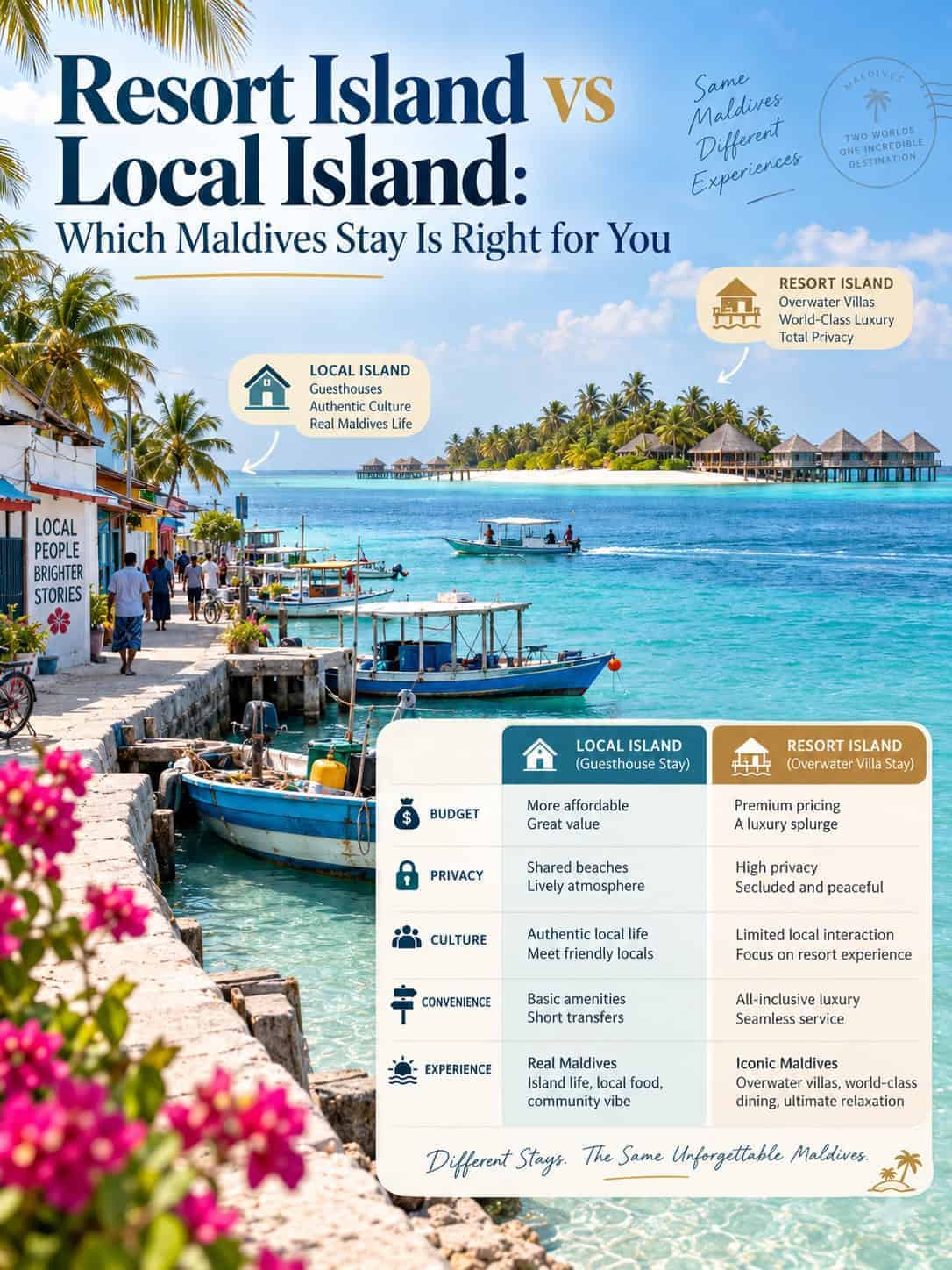
The resort island vs local island question in the Maldives isn’t really about which one is objectively better — it’s about which kind of island matches what a specific trip is actually for. The two aren’t a budget version and a premium version of the same experience; they’re structurally different, governed by different rules, and built around different ideas of what a Maldives holiday should feel like. The resort island vs local island Maldives choice also decides the maldives local island rules you live by, what a resort island means for alcohol, and the local island vs resort cost. Rather than a generic pros-and-cons list, it’s more useful to look at how the choice actually plays out for a few specific kinds of travelers.
Resort Island vs Local Island Maldives: What the Two Actually Mean
A resort island is a private island leased entirely to one resort operator — no permanent local population, no other businesses, and rules set by the resort itself, including the freedom to serve alcohol and allow swimwear anywhere on the property. A local island, by contrast, is an inhabited Maldivian community — homes, mosques, shops, a working harbor — where a share of guesthouses and small tour operators cater to tourism, but the island itself runs under the country’s standard local laws, including a ban on alcohol and expectations of modest dress outside the designated tourist beach areas. That one distinction — private leased island versus inhabited community — explains almost every other practical difference between the two.
The Honeymoon Couple
For a short, privacy-focused honeymoon, a resort island almost always wins. The appeal is specifically the things a local island can’t offer: an overwater villa, a private beach, alcohol with dinner, and an atmosphere built entirely around couples rather than a working community going about its day. A local-island honeymoon isn’t impossible, but it trades away most of what people are actually picturing when they imagine a Maldives honeymoon in the first place — worth knowing before booking, not after arrival. Our list of honeymoon resorts shows what the resort side looks like.
The Budget-Conscious Diver
This is where local islands genuinely compete, and often win. A guesthouse on a dive-focused local island like Rasdhoo or Maafushi costs a fraction of an equivalent resort stay, and the diving itself — booked through an independent local dive center rather than a resort’s in-house operator — often reaches many of the same nearby sites at a noticeably lower price per dive. For a diver whose actual priority is time underwater rather than a private beach, a local island can deliver more diving per dollar than a resort stay would.
The Family With Young Kids
This one tends to favor resort islands too, though for different reasons than the honeymoon case. Family-oriented resorts offer a shallow, enclosed house lagoon, a supervised kids’ club, and family or connecting villa configurations purpose-built for exactly this kind of trip (see our family resorts guide) — amenities a local island generally doesn’t have an equivalent of. A local island can still work for an easygoing family comfortable with a more modest setup and a bit more improvisation, but it asks more of the parents than a resort built specifically around young children does.
The Culturally Curious First-Timer
For a traveler who wants to actually see something of the Maldives beyond a resort’s manicured grounds — a working harbor, a mosque, a local market, an evening where the island isn’t entirely tourists — a local island is the only one of the two that delivers that at all. Resort islands are explicitly designed to be self-contained; stepping off the private island generally means a boat excursion rather than a walk into a town; local tours and excursions can be compared and booked in advance. A first-timer who wants a genuine sense of the country, not just its beaches, tends to come away more satisfied from a local island, even a brief one.
Maldives Local Island Rules and Alcohol Rules on Islands
See our full guide to alcohol and dress code rules in the Maldives for the complete picture, but alcohol is the starkest legal difference: resort islands can serve it freely as part of their private license, while local islands fall under the country’s general alcohol ban, with no exceptions for tourists. Dress code follows a similar pattern — resort islands allow swimwear across the property, with nudity and topless sunbathing banned there as everywhere else in the country, while local islands expect modest dress outside a designated “bikini beach” area set aside specifically for tourist swimwear. Dress rules on inhabited islands are being tightened, with island councils enforcing them together with the police, and alcohol carries real consequences: possessing or drinking it outside a resort can lead to arrest and deportation, and bottles bought at a resort may not be taken off the island, so both rules are worth knowing in advance rather than discovering on arrival. These maldives alcohol rules islands follow are the same everywhere outside resorts. The one legal drink near a guesthouse island is on a licensed safari boat: Kaani Princess, moored off Maafushi, runs a free shuttle from the harbor and serves beer for about $6. A resort day visit is the other option, such as Adaaran Prestige Vadoo near the airport at $125 per adult (18+), including the boat, lunch and unlimited drinks.
Maldives Local Island vs Resort Cost, Side by Side
A local-island guesthouse routinely costs a fraction of even a mid-range resort’s nightly rate, and that gap widens further at the luxury end of the resort market. The difference isn’t just the room itself — resort pricing typically bundles in private-island exclusivity, a broader restaurant and activity program, and amenities like a spa or kids’ club that a local island simply doesn’t offer at any price. A fair cost comparison has to weigh what’s actually being paid for, not just the nightly rate on its own. That is the core of the resort island vs local island Maldives cost question.
| Cost item | Local island guesthouse | Resort island near Malé |
|---|---|---|
| Room per night | $40-100 | From about $190-220 on half board at the cheapest resorts |
| Green tax | $6 per person per night | $12 per person per night |
| Airport transfer | A couple of dollars on the public ferry (no Friday service) or roughly $20-50 each way by shared speedboat | Resort speedboat, for example $185 per adult at Villa Nautica or $260 return per adult at Sun Siyam Olhuveli; seaplane resorts in farther atolls cost more, such as $700 return per adult at Conrad Maldives Rangali Island |
| Food and drink | About $40-70 per person a day for meals and one activity; no alcohol on the island | Lunch, drinks and excursions extra on half board, billed at resort prices |
| Taxes on the bill | 17% tourism GST, unless the quoted rate already includes it | 17% tourism GST plus a 10% service charge, unless the quote includes them |
For a couple spending four nights, a guesthouse comes to $160-400 for the room, $48 in green tax and $80-200 for return shared speedboats, or $288-648 before meals. Four nights at a half-board resort from $190-220 come to $760-880 for the room and $96 in green tax, and the boat adds $370 for two at Villa Nautica or $520 at Sun Siyam Olhuveli, before lunches, drinks and service charge.
Can You Combine Both in One Trip?
Yes, and for a lot of first-time visitors, this is the best answer of all rather than picking one over the other. Splitting a trip between a local island and a resort shows both sides of the country without fully committing to either one’s trade-offs — the approach covered in more detail in our 7-day resort and local island itinerary.
Plan the hop between the two around the boats. Resort speedboats leave from the airport jetty and some resorts do not let outside boats dock, so the usual route from a guesthouse island to a resort runs back through Malé or the airport. Public ferries do not run on Fridays, which makes that the day to book a shared speedboat or schedule the resort leg.
The Solo Traveler
Solo travel tilts toward local islands more often than resort marketing might suggest. Resorts are generally priced per villa rather than per person, which makes a solo stay disproportionately expensive compared to splitting the same cost between a couple or a group. Local-island guesthouses, by contrast, price per room the same way but at a much lower base rate, so a solo guest’s whole nightly bill is the $40-100 room plus $6 green tax, and the social atmosphere of a guesthouse — shared dining areas, group excursions booked with other guests — tends to suit a solo traveler looking for some built-in company better than an isolated overwater villa does.
A Note on First Impressions
Marketing photos of the Maldives are almost always resort photos — overwater villas, private sandbanks, infinity pools — which can leave first-time visitors assuming that’s simply what “the Maldives” looks like. Local islands look completely different: modest buildings, a working harbor, motorbikes on narrow streets, and a beach shared with other guesthouse visitors rather than a private stretch of sand. Neither picture is more “authentic” than the other in an objective sense, but it’s worth going in with accurate expectations for whichever one gets booked, rather than picturing one and arriving at the other. Maafushi, the busiest guesthouse island, has around 4,500 residents and its bikini beach at the northern tip; Thulusdhoo has two bikini beaches and a surf break off the reef; Fulidhoo is a village of about 400 people with its swimwear beach on the eastern shore and no ATM, so bring cash. When you are ready to travel, you can compare flights to Malé, book airport transfers in advance, and set up a Maldives eSIM before you land.
Frequently Asked Questions
What’s the difference between a resort island and a local island in the Maldives?
A resort island is a private island leased entirely to one operator, with resort-set rules including alcohol service. A local island is an inhabited Maldivian community with shops, mosques, and guesthouses, governed by the country’s standard local laws, including a ban on alcohol outside resort islands.
Can you drink alcohol on a local island in the Maldives?
No. Alcohol is only legally available on resort islands as part of their private operating license, and on licensed safari boats, including floating bars moored off some guesthouse islands such as Maafushi. Local islands fall under the national alcohol ban, with no exceptions made for tourists.
Is a local island cheaper than a resort in the Maldives?
Generally yes, often significantly so. A local-island guesthouse room typically costs $40-100 a night against about $190-220 on half board at the cheapest resorts near Malé, and the green tax is $6 instead of $12 per person per night, though resort pricing also includes private-island exclusivity and amenities a local island doesn’t offer.
Can you visit both a resort island and a local island on the same trip?
Yes, and it’s a common and effective way to see both sides of the Maldives in one trip rather than choosing only one, though it does require planning the transfer logistics between the two: resort boats run from the airport, so the switch usually goes through Malé or the airport, and public ferries do not run on Fridays.