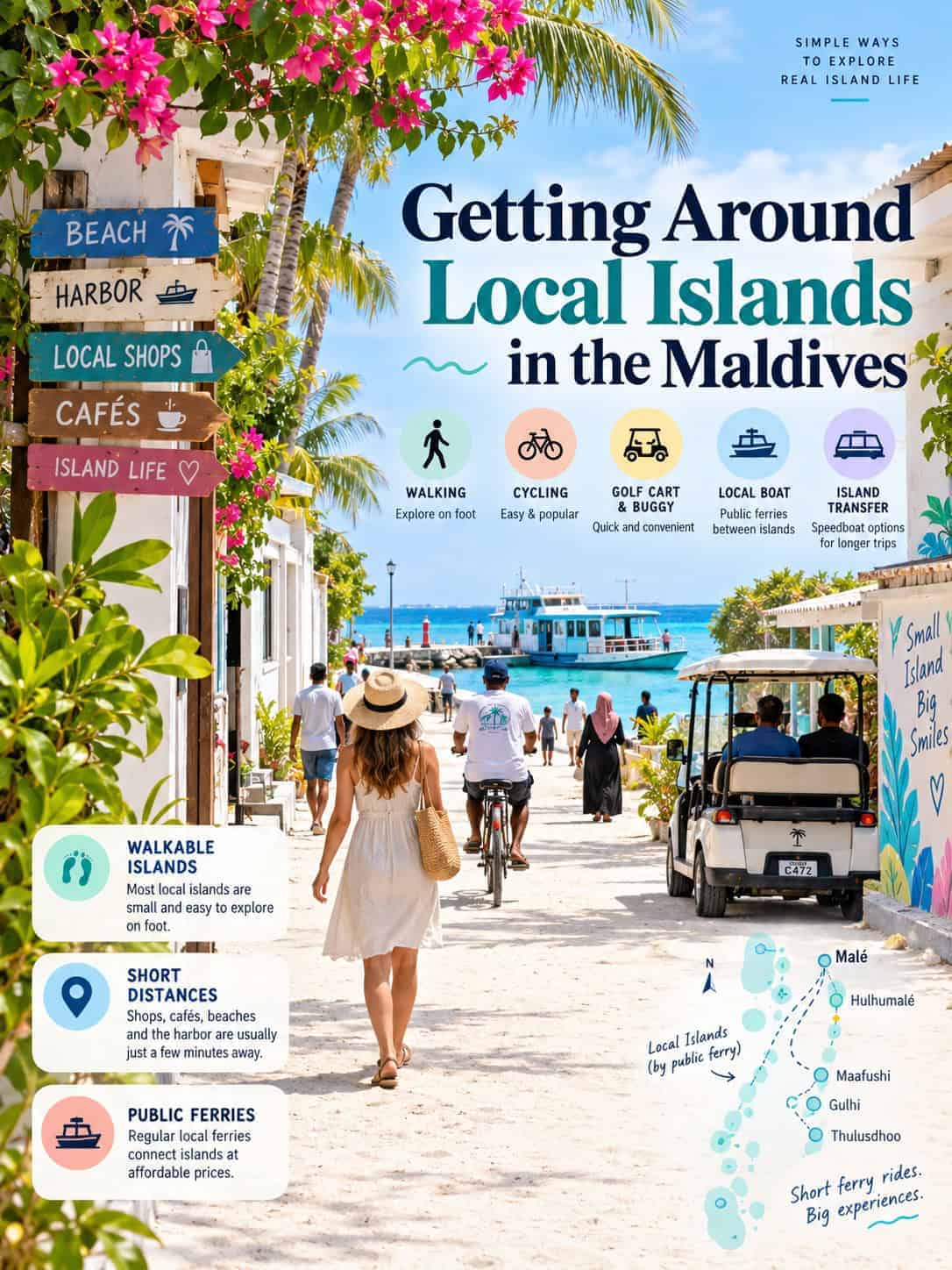
Wondering how to get around Maldives local islands? Walk or cycle on compact islands, then use public ferries or shared speedboats for longer journeys. Public boats can be economical but often operate only on selected days. Compare the departure port, travel time, ticket price and return schedule before reserving accommodation. Before you travel, you can compare flights to Malé, compare private airport transfers for the boat leg and browse day trips and excursions to see what is available.
How to Get Around Maldives Islands on Foot
Local islands like Maafushi are small enough that walking covers nearly everything. Most points of interest — the harbor, the bikini beach, guesthouses, restaurants, dive shops — sit within a 5- to 15-minute walk of each other, and crossing the island end to end often takes only a few minutes more than that. There’s rarely a reason to need faster transport for daily errands, which is part of what makes local-island life feel so different from a sprawling mainland town despite having shops, mosques, and a working harbor.
Bicycles on Maldives Local Islands
Bicycle rental is widely available through guesthouses and small local shops, typically for a modest daily rate — often somewhere in the range of a few dollars a day. It’s a genuinely useful option for covering an island’s narrow paths a bit faster, or for carrying something back from the shops without a long walk, though on an island as compact as Maafushi it’s more of a convenience than a necessity.
How to Get Around Maldives Without a Car
This is where expectations from other beach destinations tend to break down. Scooter and motorbike rental isn’t generally offered to tourists on small local islands, even though residents do ride them — it’s simply not part of the visitor transport setup the way it is on, say, a Southeast Asian island. There are no taxis on an island the size of Maafushi, no car rentals, no ride-hailing apps, and no public buses within the island itself. None of this is a gap in infrastructure so much as a reflection of scale: these islands are often walkable end to end in minutes, so none of that infrastructure has a reason to exist. The exceptions are the bigger islands. Addu’s main islands are joined by a road and causeway, so taxis and bicycles are a realistic way to get around there, and Fuvahmulah has taxis from its airport. In Greater Malé, the government Malé Taxi Line charges fixed fares: MVR 30 within Malé and MVR 70 from Malé to the airport.
Guesthouse Carts and Luggage Transfers
Some guesthouses offer a golf cart specifically to move luggage between the jetty and the guesthouse itself, particularly useful for a heavier suitcase on arrival or departure day. This isn’t a general-purpose taxi service, though — it’s worth arranging in advance directly with the guesthouse rather than expecting one to be waiting at the dock, and it’s specifically for bags rather than a lift around the island.
How to Get Around Maldives Between Islands
Once the trip involves moving from one island to another — from a local island back to Malé, or on to a different local island — the method shifts entirely to the sea. The government-run public ferry network is the cheapest option, running fixed routes on a set (and sometimes limited) weekly schedule. Speedboats cover the same routes faster and more flexibly, including days the public ferry doesn’t run, at a noticeably higher price. Traditional wooden boats called dhonis are still used for some shorter local routes and informal transport between nearby islands, particularly for trips that don’t justify a full speedboat charter — Thulusdhoo‘s surf breaks across the channel and off neighboring Himmafushi, for example, are reached this way, while its home break, Cokes, is a 5-10 minute paddle from the beach.
Day Trips Versus Scheduled Island Transfers
Beyond the point-to-point ferry and speedboat network, local islands also run day-excursion boats — chartered specifically for sandbank trips, snorkeling tours, and dolphin cruises rather than for getting somewhere. These are typically booked directly through a guesthouse or an independent local operator rather than through the same system as inter-island ferries, and they’re worth thinking of as a separate category of “getting around” built entirely around tourism rather than transport.
Plan Your Maldives Ferry Schedule Before Booking
Because the inter-island ferry network runs on a limited schedule rather than continuously, it’s worth checking ferry days and departure times before finalizing which local island to base a trip around, rather than assuming transport will simply be available whenever it’s needed. This matters most for travelers planning to visit more than one local island, or combining a local-island stay with a resort, where a missed or nonexistent ferry connection can mean an unplanned extra night or a costlier speedboat instead. Fulidhoo shows how this works: the public ferry leaves Malé only on Sunday, Tuesday and Thursday at 10:00 and comes back on Monday, Wednesday and Saturday mornings, so a Wednesday arrival means a night in Malé or the $40 shared speedboat.
Maldives Public Transport: Routes and Tickets
The government ferry system connects Malé to dozens of inhabited local islands on routes that run a few times a week rather than daily in many cases, with better frequency on busier routes like Malé to Maafushi and sparser schedules to quieter islands. Routes are typically numbered rather than named, and schedules are published by the national transport authority but worth double-checking locally, since timings can shift around public holidays or get cancelled in rough weather. On the main tourist lines, route 308 runs from Malé via Himmafushi, Huraa and Thulusdhoo to Dhiffushi, and route 303 goes to Rasdhoo, Ukulhas and Thoddoo. The exact schedule and pricing for the Malé-Maafushi route specifically is covered in more detail in our budget itinerary guide; the pattern described there — a slow, cheap public option alongside a faster, pricier speedboat — holds across most of the local-island ferry network, not just that one route.
Maldives Ferry Schedule: Practical Route Examples
Use the table below to compare published route examples, not as a live departure board. Public ferries leave from Malé city, not the airport; shared speedboats pick up at the airport jetty and run on their own timetables.
| Route | Published journey time | Example service | Important detail |
|---|---|---|---|
| Malé – Maafushi | About 90–100 minutes | Public ferry | About $3 for tourists, paid in cash; leaves Malé at 15:00 Saturday to Thursday, returns around 07:30 |
| Malé – Gulhi | About 75–80 minutes | Public ferry | Same afternoon ferry as Maafushi, Saturday to Thursday |
| Maafushi – Guraidhoo | About 20–25 minutes | Public ferry | Useful for trips within the same island chain |
| Malé – Fulidhoo | About 200 minutes | Public ferry | Leaves Malé Sunday, Tuesday and Thursday at 10:00; returns Monday, Wednesday and Saturday mornings |
| Malé/airport – Maafushi | About 45 minutes | Shared speedboat | About US$25 per person each way; several departures a day, Fridays included |
| Malé – Thulusdhoo | About 1.5–2 hours | Public ferry (route 308) | A few dollars, cash; leaves Malé around 2:30 p.m., returns early morning; no Friday service |
| Airport – Thulusdhoo | About 25–35 minutes | Shared speedboat | About US$30 per person each way |
| Airport – Fulidhoo | About 1 hour | Shared speedboat | About US$40 per person each way; on Fridays only one morning boat runs in each direction |
| Malé – Rasdhoo | About 3 hours | Public ferry (route 303) | A few dollars; morning departures a few days a week, never on Fridays |
| Airport – Rasdhoo | About 1 hour 10 minutes | Shared speedboat | US$30–50 per person each way; departures around 10:30 a.m. and 4 p.m. |
| Airport – Dhigurah | About 2 hours | Shared speedboat | About US$60 per person each way; leaves 11 a.m. and 4 p.m. (10 a.m. and 4:15 p.m. on Fridays); the public ferry, with a change at Mahibadhoo, takes 6–7 hours |
| Airport – Malé | About 10 minutes | Airport ferry | MVR 15 (MVR 20 before 6 a.m.), cash; every 15 minutes in the daytime, every day including Fridays |
To catch a public ferry after landing, cross to Malé first on the airport ferry or by taxi over the Sinamalé Bridge (MVR 70). Shared speedboat seats are booked through your guesthouse, which meets you at arrivals. Speedboat prices depend on the provider, pickup point and date.
MTCC Public Ferry Departures and Arrival Times
| Route | Days | Departs and arrives | Journey | Fare |
|---|---|---|---|---|
| Malé to Maafushi (route 309) | Saturday to Thursday | 15:00, arrives about 16:40 | About 1 hour 40 minutes | MVR 22 |
| Maafushi to Malé (route 309) | Saturday to Thursday | 07:25, arrives 09:05 | About 1 hour 40 minutes | MVR 22 |
| Malé to Maafushi (route 306) | Sunday, Tuesday, Thursday | 10:00, arrives 11:30 | About 1 hour 30 minutes | MVR 22 |
| Malé to Guraidhoo (route 309) | Saturday to Thursday | 15:00, arrives about 17:05 | About 2 hours 5 minutes | About MVR 22 |
| Malé to Thulusdhoo (route 308) | Saturday to Thursday | 14:30, arrives 16:00 | About 1 hour 30 minutes | About MVR 22 |
| Malé to Dhiffushi (route 308) | Saturday to Thursday | 14:30, arrives about 16:40 | About 2 hours 10 minutes | MVR 22 |
| Malé to Ukulhas (route 303) | Monday, Thursday | 09:00, arrives about 13:05 | About 4 hours 5 minutes | About $3.50 |
| Ukulhas to Malé (route 303) | Sunday, Wednesday | 09:45, arrives about 14:10 | About 4 hours 25 minutes | About $3.50 |
| Malé to Fulidhoo (route 306) | Sunday, Tuesday, Thursday | 10:00, arrives about 13:20 | About 3 hours 20 minutes | About MVR 53 |
| Fulidhoo to Malé (route 306) | Saturday, Monday, Wednesday | About 10:45 (some tables say 10:30), arrives about 14:05 | About 3 hours 20 to 35 minutes | About MVR 53 |
The inter-island public ferries do not run on Fridays. The fares are the published amounts in rufiyaa; some guesthouses quote about $2 to $3 for foreign visitors on the Maafushi route, so ask when you book. Ferries leave from the public jetty in Malé, and the temporary jetty location can change, so confirm it with your guesthouse. The short commuter ferries between Malé, Hulhumalé and Villimalé cost MVR 5.50 or MVR 10 depending on the source and take 10 to 25 minutes.
| Shared speedboat | Departures | Time | Fare |
|---|---|---|---|
| Velana Airport jetty to Maafushi | 07:30, 09:00, 10:25, 13:10, 15:25, 18:10, 21:30 | About 45 minutes | About $25 to $30 each way |
| Malé to Maafushi | 07:45, 09:15, 10:45, 13:30, 15:40, 18:30, 22:00 | About 30 to 45 minutes | About $25 to $30 each way |
| Malé to Dhiffushi | From about 08:30, depends on the operator | About 40 to 50 minutes | MVR 300, or $25 to $50 depending on the source |
How to Pay for Maldives Ferry and Speedboat Tickets
Ferry and speedboat tickets on local routes are often sold in person, in cash, rather than booked online in advance the way an international flight would be. It’s worth carrying small denominations of Maldivian rufiyaa or US dollars specifically for this, since island jetties and ticket counters aren’t always set up for card payments the way a guesthouse front desk might be. Showing up to a ferry departure without cash in hand is a common, avoidable way to miss a boat that only runs a few times that week.
MTCC public ferries take rufiyaa cash only: in Malé you buy the ticket at the terminal counter before boarding, and on the outer islands a crew member sells tickets on board. Shared speedboats are booked through your guesthouse or the operator, and on some routes, such as Dhigurah, the fare is simply added to the guesthouse bill. Verify the departure terminal, booking reference, boarding cutoff, luggage allowance and cancellation policy. The government-backed RTL network and private speedboat companies do not operate as one unified booking system.
Accessible Maldives Island Transport
Local islands generally weren’t built with wheelchair accessibility as a design priority — paths are often sand or uneven paving, jetties can involve a step down into a boat rather than a level gangway, and few, if any, public transport options are set up for limited mobility. Anyone traveling with mobility considerations is better served contacting a specific guesthouse directly about the terrain and jetty setup before booking, since conditions vary noticeably between islands and even between jetties on the same island.
How to Travel Between Islands in Maldives Without Missing Connections
- Check if your chosen island has a direct service from the airport or requires a transfer through Malé.
- Confirm the exact departure day and last boarding time, especially for Friday arrivals.
- Ask whether the boat is a conventional ferry, an RTL high-speed ferry or a privately operated speedboat.
- Compare the round-trip cost for every passenger, including children and luggage.
- Allow a buffer before international departures; bad weather can cancel sea transport.
MTCC atoll ferries, including the Maafushi, Thulusdhoo, Fulidhoo and Rasdhoo lines, do not sail on Fridays, while the airport ferry runs every day. Shared speedboats do run on Fridays, sometimes with fewer or shifted departures, as on the Fulidhoo and Dhigurah routes. For example, MTCC publishes a separate Friday schedule for the Villimalé ferry. Never apply one island’s service pattern to the entire country.
How to Get Around Maldives: Frequently Asked Questions
Can you rent a car or scooter on a Maldives local island?
Not on small local islands like Maafushi. Local islands are generally too small to need car rentals, and scooter rental typically isn’t offered to visitors even where residents use them. Walking and bicycle rental cover nearly all on-island transport needs. Addu is the exception: its main islands are linked by road, taxis run along it, and some guesthouses there arrange bicycle and car hire.
How do you get between local islands in the Maldives?
By sea, using the government public ferry network, speedboats, or smaller dhonis for shorter local routes. The public ferry is the cheapest option but runs on a limited schedule; speedboats are faster and more flexible but cost more.
Are taxis available on local islands like Maafushi?
No. Islands like Maafushi are small enough that there’s no taxi service on the island itself. Licensed taxis do operate in Malé, which is a different scale of island entirely.
Do guesthouses offer transport from the jetty to the room?
Some do, typically a golf cart used specifically for moving luggage rather than a general taxi service. It’s worth arranging this in advance directly with the guesthouse rather than assuming it’s available on arrival.
For how to travel between islands in Maldives, decide between a public ferry and a scheduled speedboat before booking your guesthouse. Route frequency matters more than the distance shown on a map.
Does Maldives public transport operate on Fridays? Partly. The airport–Malé ferry runs every day, but MTCC atoll ferries do not sail on Fridays. Shared speedboats keep running, sometimes with fewer departures, so a Friday transfer to a local island means taking the speedboat.
Can you travel directly from the airport to Maafushi? Scheduled private speedboats can collect passengers at Velana International Airport. Conventional public island ferries generally depart from Malé, so reach Malé first by the airport ferry or a taxi over the bridge.
Is a public ferry cheaper than a speedboat? Usually, yes. The public ferry from Malé to Maafushi costs tourists about US$3, compared with around US$25 on a shared speedboat. The speedboat takes about 45 minutes, while the conventional ferry takes around 90–100 minutes.
Do you need cash to buy Maldives ferry tickets? For public ferries, yes. MTCC ferries take rufiyaa cash only, at the counter in Malé or on board on the islands, and the airport ferry is also paid in cash (MVR 15). Shared speedboats are usually booked through your guesthouse.